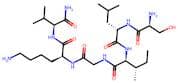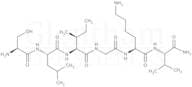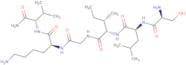
CAS 190383-13-2
:H-Ser-Leu-Ile-Gly-Lys-Val-NH2
Description:
The chemical substance identified as H-Ser-Leu-Ile-Gly-Lys-Val-NH2, with the CAS number 190383-13-2, is a peptide composed of a sequence of amino acids. This peptide features a C-terminal amide group, which enhances its stability and bioactivity compared to its carboxylic acid counterpart. The sequence includes serine (Ser), leucine (Leu), isoleucine (Ile), glycine (Gly), lysine (Lys), and valine (Val), which contribute to its unique properties and potential biological functions. Peptides like this one can exhibit various characteristics such as solubility in water, specific binding affinities to receptors, and potential roles in signaling pathways or as therapeutic agents. The presence of lysine, a positively charged amino acid, may influence the peptide's interaction with negatively charged biological molecules. Overall, the structure and composition of H-Ser-Leu-Ile-Gly-Lys-Val-NH2 suggest it may have applications in biochemistry and pharmacology, particularly in the development of peptide-based drugs or as research tools in studying protein interactions.
Formula:C28H54N8O7
Synonyms:- Protease-Activated Receptor-2 Agonist, Amide
- Proteinase Activated Receptor 2 (1-6) Amide (Human)
- Proteinase Activated Receptor 2 Agonist Peptide Sligkv Amide, Human
- Ser-Leu-Ile-Gly-Lys-Val-Amide
- Ser-Leu-Ile-Gly-Lys-Val-Nh2
- Sligkvamide
- Sligkv-Nh2
- Par-2 Agonist Peptide (Sligkv) Amide, Human
Sort by
Purity (%)
0
100
|
0
|
50
|
90
|
95
|
100
Found 6 products.
Protease-Activated Receptor-2, amide
CAS:Protease-Activated Receptor-2, amidePurity:≥98%Molecular weight:614.78g/molProtease-Activated Receptor-2, amide
CAS:Protease-Activated Receptor-2, amide (SLIGKV-NH2) is an agonist of PAR2 (IC50 : 10.4 M)Formula:C28H54N8O7Purity:>99.99%Color and Shape:SolidMolecular weight:614.78H-Ser-Leu-Ile-Gly-Lys-Val-NH2
CAS:H-Ser-Leu-Ile-Gly-Lys-Val-NH2 is a synthetic peptide that is a cyclase inhibitor. It binds to the receptor for neurokinin 1, which has been shown to inhibit lacrimal gland function in rats. The compound also inhibits the synthesis of epidermal growth factor and has been shown to have anti-inflammatory effects in mouse models. H-Ser-Leu-Ile-Gly-Lys-Val-NH2 has also been shown to inhibit protease activity in rat prostate cells and can be used as a chemical inhibitor for proteases.Formula:C25H54N8O7Purity:Min. 95%Molecular weight:614.79 g/molPAR-2 (1-6) amide (human) trifluoroacetate salt
CAS:PAR-2 (1-6) amide (human) trifluoroacetate salt H-Ser-Leu-Ile-Gly-Lys-Val-NH2 trifluoroacetate salt is a protease inhibitor that inhibits the activity of PAR2, a protein receptor. PAR2 is implicated in cancer and inflammation. It has been shown to inhibit growth factor signaling, as well as activate toll-like receptor 4 and other inflammatory pathways. PAR2 inhibition has also been studied in vivo and found to be effective in treating wild type mice with melanoma cells. In vitro studies have shown that PAR2 inhibition by PAR 2 (1-6) amide (human) trifluoroacetate salt H-Ser-Leu-Ile-Gly-Lys-Val NH2 trifluoroacetate salt blocks the production of tumour necrosis factor alpha and interleukin 6.Formula:C28H54N8O7Purity:Min. 95%Molecular weight:614.78 g/molPAR-2 (1-6) amide (human)
CAS:SLIGKV-amide, which corresponds to the tethered ligand sequence of human PAR-2 (protease activated receptor 2), can be used to investigate receptor functions.Formula:C28H54N8O7Purity:> 98%Color and Shape:White LyophilisateMolecular weight:614.79