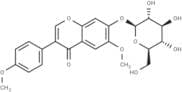
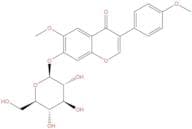
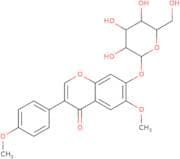
CAS 19046-26-5
:Wistin
Description:
Wistin, with the CAS number 19046-26-5, is a chemical compound that belongs to the class of substances known as alkaloids. Alkaloids are naturally occurring organic compounds that mostly contain basic nitrogen atoms and are known for their pharmacological effects. Wistin is characterized by its complex molecular structure, which contributes to its biological activity. It is often studied for its potential therapeutic applications, particularly in the fields of medicine and pharmacology. The compound may exhibit various properties, including solubility in specific solvents, stability under certain conditions, and reactivity with other chemical agents. Its biological activity can include effects on neurotransmitter systems or other physiological processes, making it of interest for research into new drug development. However, detailed information regarding its specific properties, such as melting point, boiling point, and specific applications, would require further investigation through scientific literature or databases.
Formula:C23H24O10
InChI:InChI=1S/C23H24O10/c1-29-12-5-3-11(4-6-12)14-10-31-15-8-17(16(30-2)7-13(15)19(14)25)32-23-22(28)21(27)20(26)18(9-24)33-23/h3-8,10,18,20-24,26-28H,9H2,1-2H3/t18-,20-,21+,22-,23-/m1/s1
InChI key:InChIKey=YLYJXNTZVUEFJZ-DODNOZFWSA-N
SMILES:O=C1C=2C(=CC(O[C@@H]3O[C@H](CO)[C@@H](O)[C@H](O)[C@H]3O)=C(OC)C2)OC=C1C4=CC=C(OC)C=C4
Synonyms:- 4H-1-Benzopyran-4-one, 7-(β-D-glucopyranosyloxy)-6-methoxy-3-(4-methoxyphenyl)-
- Afromosin 7-O-glucoside
- Afromosin 7-O-β-D-glucopyranoside
- 7-(β-D-Glucopyranosyloxy)-6-methoxy-3-(4-methoxyphenyl)-4H-1-benzopyran-4-one
- Wistin
Sort by
Purity (%)
0
100
|
0
|
50
|
90
|
95
|
100
Found 3 products.
Wistin
CAS:Wistin, isolated from Caragana sinica roots, is a PPARα and PPARγ agonist [1] [2] .Formula:C23H24O10Color and Shape:SolidMolecular weight:460.43Afrormosin-7-glucoside
CAS:Afrormosin-7-glucoside is a naturally occurring isoflavonoid glucoside, which is primarily derived from plant sources known for producing bioactive compounds, such as legumes. It is typically found in various species within the Fabaceae family, renowned for their high isoflavonoid content. The compound exhibits its physiological activity through the modulation of pathways associated with oxidative stress and inflammation, primarily due to its antioxidant properties.
Purity:Min. 95%