![4-[3-(5-BROMO-2-PROPOXYPHENYL)-5-(4-CHLOROPHENYL)-1H-PYRROL-2-YL]PYRIDINE](/_next/image/?url=https%3A%2Fstatic.cymitquimica.com%2Fcas-image%2Fthumb-webp%2F347863-4-3-5-bromo-2-propoxyphenyl-5-4-chlorophenyl-1h-pyrrol-2-yl-pyridine.webp&w=3840&q=75)
CAS 191034-25-0
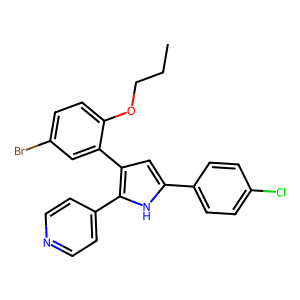
:4-[3-(5-BROMO-2-PROPOXYPHENYL)-5-(4-CHLOROPHENYL)-1H-PYRROL-2-YL]PYRIDINE
Description:
4-[3-(5-Bromo-2-propoxyphenyl)-5-(4-chlorophenyl)-1H-pyrrol-2-yl]pyridine, with the CAS number 191034-25-0, is a synthetic organic compound characterized by its complex molecular structure, which includes a pyridine ring and a pyrrole moiety. The presence of bromine and chlorine substituents on the aromatic rings contributes to its potential biological activity and lipophilicity. This compound is likely to exhibit interesting pharmacological properties due to the combination of its heterocyclic and aromatic components, which can influence its interactions with biological targets. Its solubility and stability may vary depending on the solvent and environmental conditions, making it important for applications in medicinal chemistry and drug development. Additionally, the presence of the propoxy group may enhance its pharmacokinetic profile. As with many compounds containing halogens, it is essential to consider the environmental and safety implications of its use and disposal. Overall, this compound represents a class of molecules that could be explored for therapeutic applications, particularly in the fields of oncology or neurology.
Formula:C24H20BrClN2O
InChI:InChI=1/C24H20BrClN2O/c1-2-13-29-23-8-5-18(25)14-20(23)21-15-22(16-3-6-19(26)7-4-16)28-24(21)17-9-11-27-12-10-17/h3-12,14-15,28H,2,13H2,1H3
SMILES:CCCOc1ccc(cc1c1cc(c2ccc(cc2)Cl)[nH]c1c1ccncc1)Br
Synonyms:- L-168,049
Sort by
Purity (%)
0
100
|
0
|
50
|
90
|
95
|
100
Found 4 products.
Pyridine, 4-[3-(5-bromo-2-propoxyphenyl)-5-(4-chlorophenyl)-1H-pyrrol-2-yl]-
CAS:Formula:C24H20BrClN2OPurity:99%Color and Shape:SolidMolecular weight:467.7854Glucagon Receptor Antagonist II
CAS:Glucagon receptor antagonists II are a class of drugs that inhibit the activity of glucagon receptors. These drugs have been shown to increase blood glucose levels in patients with type 2 diabetes and bowel disease. Glucagon receptor antagonists II bind to the glucagon receptor and block the binding of glucagon, preventing it from activating its downstream signaling pathways. The activation of these pathways leads to elevated blood glucose levels, which can be beneficial for patients with type 2 diabetes. Glucagon receptor antagonists II are currently being studied for potential applications in inflammatory bowel disease, obesity, and insulin resistance.Formula:C24H20BrClN2OPurity:Min. 95%Molecular weight:467.79 g/molL-168049
CAS:L-168049: Human glucagon receptor antagonist, IC50 - 3.7 nM human, 63 nM murine, 60 nM canine.Formula:C24H20BrClN2OPurity:>99.99%Color and Shape:SolidMolecular weight:467.79Ref: TM-T22893
1mg50.00€5mg105.00€10mg170.00€25mg358.00€50mg530.00€100mg758.00€500mg1,558.00€1mL*10mM (DMSO)116.00€
![Pyridine, 4-[3-(5-bromo-2-propoxyphenyl)-5-(4-chlorophenyl)-1H-pyrrol-2-yl]-](/_next/image/?url=https%3A%2Fstatic.cymitquimica.com%2Fproducts%2FIN%2Fthumb%2FDA002F0Q.jpg&w=3840&q=75)