CAS 1912-41-0
:7-Chloro-1H-indole-3-acetic acid
Description:
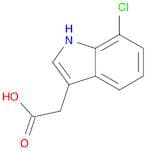
7-Chloro-1H-indole-3-acetic acid, with the CAS number 1912-41-0, is a synthetic compound that belongs to the class of indole derivatives. It is characterized by the presence of a chlorine atom at the 7-position of the indole ring and an acetic acid functional group at the 3-position. This compound is often studied for its biological activity, particularly in plant growth regulation, as it exhibits auxin-like properties, influencing various physiological processes in plants. The molecular structure contributes to its potential as a herbicide or growth regulator. In terms of solubility, it is generally soluble in organic solvents and may have limited solubility in water, which is typical for many indole derivatives. Its stability and reactivity can vary depending on environmental conditions, such as pH and temperature. Additionally, 7-Chloro-1H-indole-3-acetic acid is of interest in medicinal chemistry, where it may serve as a lead compound for developing new therapeutic agents.
Formula:C10H8ClNO2
InChI:InChI=1S/C10H8ClNO2/c11-8-3-1-2-7-6(4-9(13)14)5-12-10(7)8/h1-3,5,12H,4H2,(H,13,14)
InChI key:InChIKey=IFOAZUXPPBRTBS-UHFFFAOYSA-N
SMILES:C(C(O)=O)C=1C=2C(NC1)=C(Cl)C=CC2
Synonyms:- (7-chloro-1H-indol-3-yl)acetic acid
- 1H-Indole-3-acetic acid, 7-chloro-
- 2-(7-Chloro-1H-indol-3-yl)acetic acid
- 7-Chloro-1H-indole-3-acetic acid
- 7-Chloro-IAA
- 7-Chloroindole-3-acetic acid
- Indole-3-acetic acid, 7-chloro-
- Sr 052
Sort by
Purity (%)
0
100
|
0
|
50
|
90
|
95
|
100
Found 4 products.
1H-Indole-3-acetic acid, 7-chloro-
CAS:Formula:C10H8ClNO2Purity:95%Color and Shape:SolidMolecular weight:209.62902-(7-Chloro-1H-indol-3-yl)acetic acid
CAS:2-(7-Chloro-1H-indol-3-yl)acetic acidPurity:95%Molecular weight:209.63g/mol2-(7-Chloro-1H-indol-3-yl)acetic acid
CAS:Formula:C10H8ClNO2Purity:95.0%Color and Shape:SolidMolecular weight:209.637-Chloro-1H-indole-3-acetic Acid
CAS:7-Chloro-1H-indole-3-acetic Acid is a microbial metabolite that is the product of the anthranilic acid pathway. This compound has been found to be synthesized by some strains of organisms and can be used as a substrate for the synthesis of other compounds, such as kynurenine. The racemase enzyme converts this compound into its biologically active form, which is then converted into a fluorescent molecule by an unknown biological mechanism.Formula:C10H8ClNO2Purity:Min. 95%Molecular weight:209.63 g/mol