CAS 19128-48-4
:2-Bromo-1-chloro-3-nitrobenzene
Description:
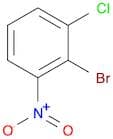
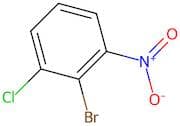
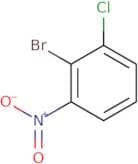
2-Bromo-1-chloro-3-nitrobenzene is an aromatic compound characterized by the presence of bromine, chlorine, and nitro functional groups attached to a benzene ring. Its molecular structure features a bromine atom at the second position, a chlorine atom at the first position, and a nitro group at the third position of the benzene ring, contributing to its reactivity and physical properties. This compound is typically a pale yellow solid at room temperature and is known for its moderate solubility in organic solvents such as ethanol and acetone, while being less soluble in water. The presence of multiple halogen and nitro substituents influences its chemical behavior, making it a potential candidate for various chemical reactions, including nucleophilic substitutions and electrophilic aromatic substitutions. Additionally, 2-Bromo-1-chloro-3-nitrobenzene may exhibit biological activity, which can be of interest in pharmaceutical research. Safety precautions should be taken when handling this compound, as it may pose health risks due to its halogenated nature and potential toxicity.
Formula:C6H3BrClNO2
InChI:InChI=1S/C6H3BrClNO2/c7-6-4(8)2-1-3-5(6)9(10)11/h1-3H
SMILES:c1cc(c(c(c1)N(=O)=O)Br)Cl
Synonyms:- 2-Bromo-3-Chloronitrobenzene
Sort by
Purity (%)
0
100
|
0
|
50
|
90
|
95
|
100
Found 4 products.
Benzene, 2-bromo-1-chloro-3-nitro-
CAS:Formula:C6H3BrClNO2Purity:98%Color and Shape:SolidMolecular weight:236.4505Ref: IN-DA002F5N
1g25.00€5g31.00€10g52.00€25g81.00€50g128.00€100g160.00€500gTo inquire100mg21.00€250mg25.00€2-Bromo-1-chloro-3-nitrobenzene
CAS:Formula:C6H3BrClNO2Purity:95%Color and Shape:SolidMolecular weight:236.452-Bromo-3-chloronitrobenzene
CAS:2-Bromo-3-chloronitrobenzene is an estrogenic compound that binds to the estrogen receptor. It has been shown to have anticancer activity in animal studies, which may be due to its ability to inhibit transcriptional activity and induce apoptosis. 2-Bromo-3-chloronitrobenzene has been used as a starting material for synthesis of other compounds and exhibits moderate affinity for the estrogen receptor. This compound can be synthesized by a palladium-catalyzed cross-coupling reaction of 2-bromobenzyl bromide and chloroacetone, followed by treatment with salicylaldoxime in the presence of base.
Formula:C6H3BrClNO2Purity:Min. 95%Molecular weight:236.45 g/mol