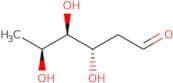
CAS 19165-06-1
:2-deoxy-L-fucose
Description:
2-Deoxy-L-fucose is a monosaccharide and a derivative of fucose, characterized by the absence of an oxygen atom at the second carbon position, which distinguishes it from its parent compound. This sugar is an aldohexose, meaning it contains an aldehyde group, and it is typically found in a pyranose form in solution. 2-Deoxy-L-fucose plays a significant role in various biological processes, including cell signaling and the synthesis of glycoproteins and glycolipids. Its structure allows it to participate in specific interactions with proteins and other biomolecules, influencing cellular functions. The compound is often studied for its potential applications in medicinal chemistry and biotechnology, particularly in the development of therapeutics targeting glycan-related pathways. Additionally, 2-deoxy-L-fucose can be involved in the biosynthesis of certain antibiotics and is of interest in the field of glycobiology for its unique properties and functions.
Formula:C6H12O4
InChI:InChI=1/C6H12O4/c1-4(8)6(10)5(9)2-3-7/h3-6,8-10H,2H2,1H3/t4-,5-,6+/m0/s1
Synonyms:- 2,6-Dideoxy-L-lyxo-hexose
- L-lyxo-Hexose, 2,6-dideoxy-
Sort by
Purity (%)
0
100
|
0
|
50
|
90
|
95
|
100
Found 1 products.
2-Deoxy-L-fucose
CAS:2-Deoxy-L-fucose is a sugar that is found in the human body. It has been shown to have anti-tumour properties and can be used as a chemotherapeutic agent in the treatment of solid tumours. 2DFL binds to the receptor for fucose, which is expressed in many types of cancer cells. It also inhibits DNA synthesis by stabilizing a complex between the sugar and dna template, inhibiting the binding of monoclonal antibodies to cancer cells, and preventing glycosidic bond formation on cancer cells. 2DFL has also been shown to inhibit microbial biotransformation and cell culture.
Formula:C6H12O4Purity:Min. 95%Color and Shape:PowderMolecular weight:148.16 g/mol