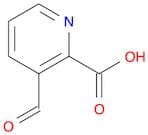
CAS 19182-29-7
:Picolinic acid, 3-formyl- (6CI,8CI)
Description:
Picolinic acid, 3-formyl- (CAS 19182-29-7) is an organic compound that belongs to the class of pyridine carboxylic acids. It features a pyridine ring with a carboxylic acid group and an aldehyde functional group at the 3-position. This compound is characterized by its ability to form chelates with metal ions, which can enhance its utility in various applications, including coordination chemistry and potential therapeutic uses. Picolinic acid derivatives are known for their biological activity, and the presence of the formyl group may influence its reactivity and interaction with biological systems. The compound is typically a white to off-white solid and is soluble in polar solvents. Its chemical properties include the ability to undergo typical reactions of carboxylic acids and aldehydes, such as oxidation and condensation. Overall, 3-formyl-picolinic acid is of interest in both synthetic organic chemistry and medicinal chemistry due to its structural features and potential applications.
Formula:C7H5NO3
Sort by
Purity (%)
0
100
|
0
|
50
|
90
|
95
|
100
Found 3 products.
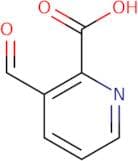
3-formylpyridine-2-carboxylic acid
CAS:3-formylpyridine-2-carboxylic acid is a phenylhydrazine derivative, which is a white crystalline solid. It is soluble in solvents such as chloroform and methanol, but insoluble in water. 3-Formylpyridine-2-carboxylic acid can be prepared by the chlorination of pyridine or by alkaline hydrolysis of its esters with sodium hydroxide. It can also be synthesized from the reaction of phenylhydrazine with formaldehyde in organic solvents. 3-Formylpyridine-2-carboxylic acid has been shown to react with carbonyl compounds to form a conjugated system through an addition reaction and to form esters that are soluble in organic solvents. The yield of this reaction depends on the solvent used and the temperature at which it is carried out.
Formula:C7H5NO3Purity:Min. 95%Molecular weight:151.1 g/mol