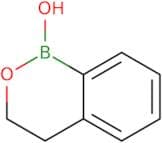
CAS 19206-51-0
:2-(2-HYDROXYETHYL)BENZENEBORONIC ACID DEHYDRATE 95
Description:
2-(2-Hydroxyethyl)benzeneboronic acid hydrate, with the CAS number 19206-51-0, is an organoboron compound characterized by the presence of a boronic acid functional group attached to a benzene ring that is further substituted with a hydroxyethyl group. This compound typically appears as a white to off-white solid and is soluble in water due to the presence of the hydroxyethyl group, which enhances its hydrophilicity. It is often used in organic synthesis, particularly in Suzuki-Miyaura cross-coupling reactions, which are pivotal in forming carbon-carbon bonds. The boronic acid moiety allows for the formation of stable complexes with diols, making it useful in various applications, including drug development and materials science. Additionally, the compound may exhibit properties such as pH sensitivity and the ability to act as a Lewis acid, which can influence its reactivity and interactions in chemical processes. Proper handling and storage conditions are essential to maintain its stability and effectiveness in applications.
Formula:C8H9BO2
InChI:InChI=1/C8H9BO2/c10-9-8-4-2-1-3-7(8)5-6-11-9/h1-4,10H,5-6H2
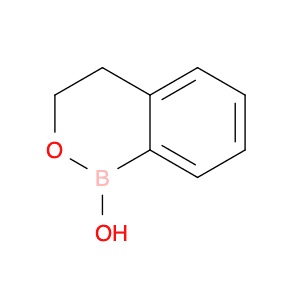
SMILES:c1ccc2c(c1)CCOB2O
Synonyms:- 2-(2-Hydroxyethyl)phenylboronic acid, dehydrated
- 2-(2-Hydroxyethyl)phenylboronic acid
- 1-Hydroxy-3,4-Dihydro-2,1-Benzoxaborinine
- 2-(2-Hydroxyethyl)benzeneboronic acid dehydrate 95%
Sort by
Purity (%)
0
100
|
0
|
50
|
90
|
95
|
100
Found 4 products.
1H-2,1-Benzoxaborin, 3,4-dihydro-1-hydroxy-
CAS:Formula:C8H9BO2Purity:95%Color and Shape:SolidMolecular weight:147.96692-(2-Hydroxyethyl)benzeneboronic acid dehydrate
CAS:2-(2-Hydroxyethyl)benzeneboronic acid dehydrate
Formula:C8H9BO2Purity:98%Color and Shape: white solidMolecular weight:147.97g/mol2-(2-Hydroxyethyl)phenylboronic acid dehydrated
CAS:2-(2-Hydroxyethyl)phenylboronic acid dehydrated is a molecule with a hydroxyl group, a neutral ph, and a hydroxyl group. It is used in the synthesis of nitro compounds and has shown to have an inhibitory effect on protein synthesis. The compound also binds to hyaluronic acid, which may be due to its structural similarity to the sugar glucose.
Formula:C8H9BO2Purity:Min. 95%Molecular weight:147.97 g/mol

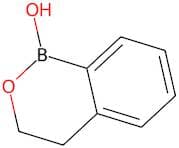

![3,4-Dihydro-1H-benzo[c][1,2]oxaborinin-1-ol](/_next/image/?url=https%3A%2Fstatic.cymitquimica.com%2Fproducts%2F10%2Fthumb%2FF216273.jpg&w=3840&q=75)