CAS 19221-08-0
:4-Hydroxy-4´-nitrostilbene
Description:
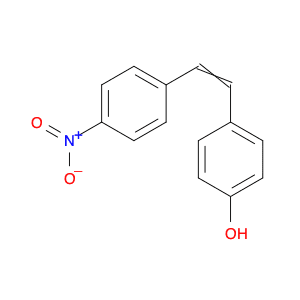
4-Hydroxy-4'-nitrostilbene is an organic compound characterized by its stilbene structure, which consists of two phenyl rings connected by a double bond. The presence of a hydroxy group (-OH) and a nitro group (-NO2) on the stilbene framework significantly influences its chemical properties and reactivity. This compound typically appears as a yellow crystalline solid and is known for its potential applications in organic electronics, photochemistry, and as a fluorescent probe due to its ability to absorb and emit light. The hydroxy group contributes to its solubility in polar solvents, while the nitro group can participate in various chemical reactions, including electrophilic substitution. Additionally, 4-Hydroxy-4'-nitrostilbene can exhibit interesting photophysical properties, making it a subject of study in materials science and photonic applications. Safety considerations should be taken into account, as nitro compounds can be hazardous, and appropriate handling and disposal procedures should be followed.
Formula:C14H11NO3
Synonyms:- 4-Hydroxy-4-nitrostilbene
- 4-Hydroxy-4?nitrostilbene
Sort by
Purity (%)
0
100
|
0
|
50
|
90
|
95
|
100
Found 4 products.
4-Hydroxy-4'-nitrostilbene, 98%
CAS:This Thermo Scientific Chemicals brand product was originally part of the Alfa Aesar product portfolio. Some documentation and label information may refer to the legacy brand. The original Alfa Aesar product / item code or SKU reference has not changed as a part of the brand transition to Thermo SciFormula:C14H11NO3Purity:98%Color and Shape:Yellow to orange to brown, Crystals or powder or crystalline powderMolecular weight:241.254'-Hydroxy-4-nitrostilbene
CAS:4'-Hydroxy-4-nitrostilbene is a chromophore that has been solubilized in water and can be used to study hydrogen bonding interactions. The 4'-hydroxyl group is the site of hydrogen bonding with the chromophore's anion, which leads to the formation of a tetrahedral intermediate. This technique has been used to study interactions between anions and nucleophiles, as well as cellular processes like cancer cell division.Formula:C14H11NO3Purity:Min. 95%Color and Shape:Yellow PowderMolecular weight:241.24 g/mol