CAS 19250-09-0
:N-(3,4-Dichlorophenyl)thiourea
Description:
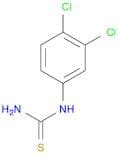
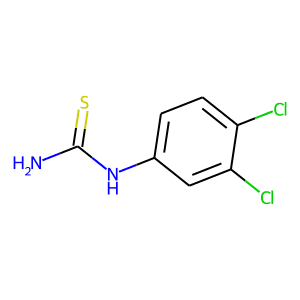
N-(3,4-Dichlorophenyl)thiourea is an organic compound characterized by its thiourea functional group, which consists of a carbon atom double-bonded to a sulfur atom and single-bonded to an amine group. This compound features a dichlorophenyl group, indicating the presence of two chlorine atoms substituted on a phenyl ring at the 3 and 4 positions. It typically appears as a solid and is known for its potential applications in pharmaceuticals and agrochemicals due to its biological activity. The presence of the dichlorophenyl moiety enhances its lipophilicity, which can influence its interaction with biological systems. N-(3,4-Dichlorophenyl)thiourea may exhibit properties such as moderate solubility in organic solvents and limited solubility in water. It is important to handle this compound with care, as it may pose health risks, including toxicity. Proper safety measures should be observed when working with this substance in laboratory or industrial settings.
Formula:C7H6Cl2N2S
InChI:InChI=1S/C7H6Cl2N2S/c8-5-2-1-4(3-6(5)9)11-7(10)12/h1-3H,(H3,10,11,12)
InChI key:InChIKey=CCNCITSJXCSXJY-UHFFFAOYSA-N
SMILES:N(C(N)=S)C1=CC(Cl)=C(Cl)C=C1
Synonyms:- (3,4-Dichlorophenyl)thiourea
- 1-(3,4-Dichlorophenyl)Thiourea
- 3,4-Dichlorophenylthiourea
- Amino[(3,4-dichlorophenyl)amino]methane-1-thione
- N-(3,4-Dichlorophenyl)thiourea
- Thiourea, (3,4-dichlorophenyl)-
- Thiourea, N-(3,4-dichlorophenyl)-
- Urea, 1-(3,4-dichlorophenyl)-2-thio-
Sort by
Purity (%)
0
100
|
0
|
50
|
90
|
95
|
100
Found 4 products.
Thiourea, N-(3,4-dichlorophenyl)-
CAS:Formula:C7H6Cl2N2SPurity:%Color and Shape:SolidMolecular weight:221.1069N-(3,4-Dichlorophenyl)thiourea
CAS:N-(3,4-Dichlorophenyl)thioureaPurity:≥95%Color and Shape:SolidMolecular weight:221.11g/mol1-(3,4-Dichlorophenyl)-2-thiourea
CAS:Formula:C7H6Cl2N2SPurity:95%Color and Shape:SolidMolecular weight:221.13,4-Dichlorophenylthiourea
CAS:3,4-Dichlorophenylthiourea is a membrane transport inhibitor that reduces the transport of chloride ions across the cell membrane. It has been shown to be effective in preventing the damage caused by glutamate and other excitotoxins. 3,4-Dichlorophenylthiourea has been shown to cause neurological damage in rats and mice. This chemical also showed an inhibitory effect on glutamate dehydrogenase from rat red cells and human erythrocytes. 3,4-Dichlorophenylthiourea has been shown to cause toxicity in humans, including bladder cancer and blood group incompatibility.
Purity:Min. 95%