


CAS 19263-11-7
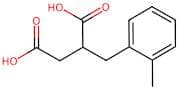
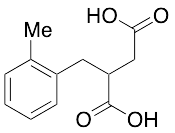
:2-(2-methylbenzyl)butanedioic acid
Description:
2-(2-Methylbenzyl)butanedioic acid, also known by its CAS number 19263-11-7, is an organic compound characterized by its dicarboxylic acid structure. It features a butanedioic acid backbone, which is substituted with a 2-methylbenzyl group at one end. This substitution imparts unique physical and chemical properties to the compound, including increased hydrophobicity due to the aromatic ring. The presence of two carboxylic acid functional groups allows for potential hydrogen bonding and reactivity, making it useful in various chemical reactions and applications. The compound is likely to be a solid at room temperature, with moderate solubility in polar solvents. Its molecular structure suggests potential applications in pharmaceuticals, agrochemicals, or as a building block in organic synthesis. Additionally, the compound may exhibit specific biological activities, although detailed studies would be necessary to elucidate its full range of properties and potential uses. As with many organic compounds, safety data should be consulted to ensure proper handling and usage.
Formula:C12H14O4
InChI:InChI=1/C12H14O4/c1-8-4-2-3-5-9(8)6-10(12(15)16)7-11(13)14/h2-5,10H,6-7H2,1H3,(H,13,14)(H,15,16)
SMILES:Cc1ccccc1CC(CC(=O)O)C(=O)O
Synonyms:- Butanedioic Acid, 2-[(2-Methylphenyl)Methyl]-
Sort by
Purity (%)
0
100
|
0
|
50
|
90
|
95
|
100
Found 4 products.
2-(2-Methylbenzyl)succinic acid
CAS:2-(2-Methylbenzyl)succinic acidPurity:95%Molecular weight:222.24g/mol2-Methylbenzylsuccinic Acid
CAS:Controlled ProductFormula:C12H14O4Color and Shape:NeatMolecular weight:222.2372-[(2-Methylphenyl)methyl]butanedioic acid
CAS:2-[(2-Methylphenyl)methyl]butanedioic acid is a nitrate that is produced by the conversion of 2-methylbenzylsuccinic acid. It can be used as an electron acceptor in microbial assays and has been shown to have the ability to mineralize carbon sources such as xylene. It has also been shown to be capable of transforming benzoate, benzylsuccinic acid, and other substrates, but it does not form benzaldehyde or other metabolic products. The enzyme responsible for its conversion is a dehydrogenase.Formula:C12H14O4Purity:Min. 95%Molecular weight:222.24 g/mol

![2-[(2-methylphenyl)methyl]butanedioic acid](/_next/image/?url=https%3A%2Fstatic.cymitquimica.com%2Fproducts%2F10%2Fthumb%2FF653543.jpg&w=3840&q=75)


![2-[(2-Methylphenyl)methyl]butanedioic acid](/_next/image/?url=https%3A%2Fstatic.cymitquimica.com%2Fproducts%2F3D%2Fthumb%2FUAA26311.jpg&w=3840&q=75)
