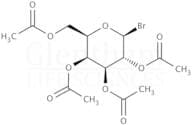
CAS 19285-38-2
:1-BROMO-2,3,4,6-TETRA-ACETYL-BETA-D-GALACTOSIDE
Description:
1-Bromo-2,3,4,6-tetra-acetyl-beta-D-galactoside is a chemical compound that belongs to the class of glycosides, specifically a brominated derivative of galactose. It features a beta configuration at the anomeric carbon, which is characteristic of many naturally occurring sugars. The presence of four acetyl groups indicates that the hydroxyl groups on the galactose molecule are acetylated, enhancing its stability and solubility in organic solvents. The bromine atom serves as a good leaving group, making this compound useful in various synthetic applications, particularly in glycosylation reactions. This compound is typically used in carbohydrate chemistry for the synthesis of more complex oligosaccharides and glycoconjugates. Its molecular structure contributes to its reactivity and potential applications in medicinal chemistry and biochemistry. As with many brominated compounds, it should be handled with care due to potential toxicity and environmental concerns.
Formula:C14H19BrO9
InChI:InChI=1/C14H19BrO9/c1-6(16)20-5-10-11(21-7(2)17)12(22-8(3)18)13(14(15)24-10)23-9(4)19/h10-14H,5H2,1-4H3/t10-,11+,12+,13-,14-/m1/s1
Synonyms:- Acetic Acid (2R,3S,4S,5R,6S)-3,4,5-Triacetoxy-6-Bromo-Tetrahydro-Pyran-2-Ylmethyl Ester
- Acetobromo-Beta-D-Galactose
- 1-Bromo-2,3,4,6-tetra-acetyl-D-galactoside
- 2,3,4,6-Tetra-O-acetyl-b-D-galactopyranosylbromide
- 1-Bromo-2,3,4,6-Tetra-Acetyl-Ss-D-Galactoside
- 2,3,4,6-tetra-O-acetyl-beta-D-galactopyranosyl bromide
- b-D-Galactopyranosyl bromide,2,3,4,6-tetraacetate
Sort by
Purity (%)
0
100
|
0
|
50
|
90
|
95
|
100
Found 2 products.
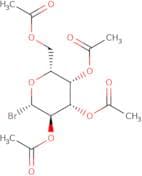
2,3,4,6-Tetra-O-acetyl-b-D-galactopyranosyl bromide
CAS:2,3,4,6-Tetra-O-acetyl-b-D-galactopyranosyl bromide is a chemical reagent with the chemical formula C6H8Br4O7. It is an argon fluorochlorohydrohalide that has been used as a reagent in organic synthesis. This compound has been shown to have antibacterial activity against faecalis and other bacteria. 2,3,4,6-Tetra-O-acetyl-b-D-galactopyranosyl bromide reacts with oxygen or halides to form reactive species such as tribromide or chloride. These reactive species may be responsible for the antibacterial properties of this compound.Formula:C14H19BrO9Purity:Min. 95%Molecular weight:411.2 g/mol