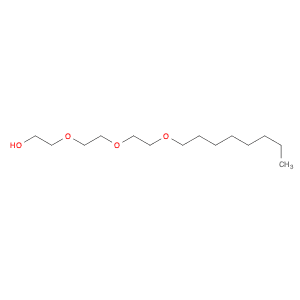
CAS 19327-38-9
:n-Octyl-trioxyethylene
Description:
n-Octyl-trioxyethylene, identified by its CAS number 19327-38-9, is a nonionic surfactant commonly used in various industrial and commercial applications. This compound is characterized by its hydrophilic (water-attracting) and lipophilic (oil-attracting) properties, which enable it to effectively reduce surface tension and enhance the solubility of hydrophobic substances in aqueous solutions. Typically, it appears as a colorless to pale yellow liquid or viscous substance, depending on its formulation and purity. Its molecular structure consists of a hydrophobic n-octyl chain and multiple ethylene oxide units, which contribute to its surfactant properties. n-Octyl-trioxyethylene is often utilized in formulations for detergents, emulsifiers, and dispersants, making it valuable in industries such as cosmetics, pharmaceuticals, and agriculture. Additionally, it exhibits good stability and compatibility with various formulations, making it a versatile ingredient in product development. Safety data should be consulted for handling and usage guidelines, as with any chemical substance.
Formula:C14H30O4
InChI:InChI=1/C14H30O4/c1-2-3-4-5-6-7-9-16-11-13-18-14-12-17-10-8-15/h15H,2-14H2,1H3
SMILES:CCCCCCCCOCCOCCOCCO
Synonyms:- Triethylene glycol monooctyl ether
- 2-{2-[2-(Octyloxy)Ethoxy]Ethoxy}Ethanol
Sort by
Purity (%)
0
100
|
0
|
50
|
90
|
95
|
100
Found 4 products.
n-Octyltrioxyethylene
CAS:The tenside C8E3 solubilizes membrane proteins.Formula:C14H30O4Molecular weight:262.39Triethylene glycol monooctyl ether
CAS:Formula:C14H30O4Purity:≥ 97.0%Color and Shape:Clear, colourless liquidMolecular weight:262.39n-Octyltrioxyethylene
CAS:n-Octyltrioxyethylene is an oral dosage form of a surfactant. It is the only non-ionic surfactant that has been shown to be effective against syncytial viruses (e.g., HIV). n-Octyltrioxyethylene is used to stain cells and tissues and has antiviral properties that inhibit virus replication by binding to the lipid membrane of the virus. This drug also has a constant, effective dose at temperatures ranging from -20˚C to 40˚C, and can be used as a drug substance in formulations for topical, ophthalmic, or inhalation administration.
Formula:C14H30O4Purity:Min. 95%Molecular weight:262.39 g/mol