CAS 1940-30-3
:2-Bromo-4,5-dichlorobenzenamine
Description:
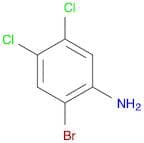
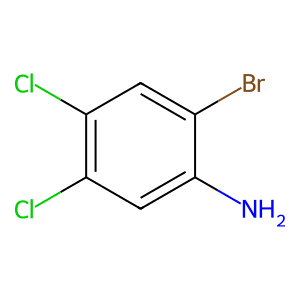
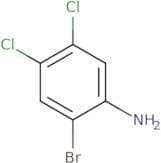
2-Bromo-4,5-dichlorobenzenamine, with the CAS number 1940-30-3, is an organic compound that belongs to the class of aromatic amines. It features a benzene ring substituted with two chlorine atoms at the 4 and 5 positions, a bromine atom at the 2 position, and an amino group (-NH2) at the 1 position. This compound is typically a solid at room temperature and may exhibit a range of colors depending on its purity and form. It is characterized by its relatively high melting point and moderate solubility in organic solvents, while being less soluble in water due to its hydrophobic aromatic structure. The presence of halogen substituents can influence its reactivity, making it a potential candidate for various chemical reactions, including nucleophilic substitutions and coupling reactions. Additionally, like many aromatic amines, it may pose health risks, including potential carcinogenicity, necessitating careful handling and appropriate safety measures in laboratory settings.
Formula:C6H4BrCl2N
InChI:InChI=1S/C6H4BrCl2N/c7-3-1-4(8)5(9)2-6(3)10/h1-2H,10H2
InChI key:InChIKey=MAMRRASCBCVQHO-UHFFFAOYSA-N
SMILES:BrC1=C(N)C=C(Cl)C(Cl)=C1
Synonyms:- 2-Bromo-4,5-dichloroaniline
- 2-Bromo-4,5-dichlorobenzenamine
- Benzenamine, 2-bromo-4,5-dichloro-
- Aniline, 2-bromo-4,5-dichloro-
Sort by
Purity (%)
0
100
|
0
|
50
|
90
|
95
|
100
Found 4 products.
Benzenamine, 2-bromo-4,5-dichloro-
CAS:Formula:C6H4BrCl2NPurity:98%Color and Shape:SolidMolecular weight:240.91272-bromo-4,5-dichloroaniline
CAS:2-bromo-4,5-dichloroaniline is a homologous compound that is used as an intermediate in the production of dopamine and polyphosphoric acid. It has been shown to inhibit the formation of hydrogen chloride and chloro compounds in the brain, which may be due to its catalytic properties. The metabolism of dopamine is inhibited by 2-bromo-4,5-dichloroaniline, which would lead to a decrease in neurotransmitters such as serotonin and noradrenaline. This drug has been found to be effective in the treatment of Parkinson's disease.Formula:C6H4BrCl2NPurity:Min. 95%Molecular weight:240.91 g/mol