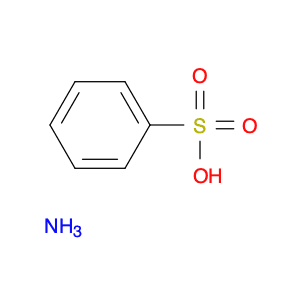
CAS 19402-64-3
:Ammonium benzenesulfonate
Description:
Ammonium benzenesulfonate, with the CAS number 19402-64-3, is an organic compound that serves as a sulfonate salt derived from benzenesulfonic acid. It typically appears as a white to off-white solid and is soluble in water, making it useful in various applications. This compound is characterized by its ammonium cation, which contributes to its solubility and reactivity. Ammonium benzenesulfonate is often utilized as a surfactant, dispersant, or emulsifying agent in industrial processes, including detergents and cleaning products. Additionally, it can act as a reagent in organic synthesis and is sometimes employed in the formulation of pharmaceuticals. The presence of the sulfonate group imparts unique properties, such as the ability to interact with both polar and nonpolar substances, enhancing its effectiveness in various chemical applications. Safety data should be consulted for handling and exposure guidelines, as with any chemical substance.
Formula:C6H6O3S·H3N
InChI:InChI=1S/C6H6O3S.H3N/c7-10(8,9)6-4-2-1-3-5-6;/h1-5H,(H,7,8,9);1H3
InChI key:InChIKey=WWLOCCUNZXBJFR-UHFFFAOYSA-N
SMILES:S(=O)(=O)(O)C1=CC=CC=C1.N
Synonyms:- Ammonium benzenesulphonate
- Benzenesulfonic Acid
- Benzenesulfonic Acid Ammoniate (1:1)
- Benzenesulfonic acid, ammonium salt
- Benzenesulfonic acid, ammonium salt (1:1)
- Ammonium benzenesulfonate
Sort by
Purity (%)
0
100
|
0
|
50
|
90
|
95
|
100
Found 4 products.
Ammonium benzenesulfonate
CAS:Formula:C6H9NO3SPurity:97%Color and Shape:SolidMolecular weight:175.2056Ammonium benzenesulfonate
CAS:Ammonium benzenesulfonate is a glycol ester that belongs to the class of ammonium salts. It is used as a synergist for the synthesis of sodium salts, which are used in analytical methods. Ammonium benzenesulfonate has been shown to have an effect on autoimmune diseases by inhibiting the production of inflammatory cytokines, such as TNF-α and IL-6, in human serum. This compound also has been shown to have a synergistic effect when combined with monoethyl ethers and sodium salts. The mechanism of this reaction is not well understood but it may be due to intramolecular hydrogen transfer or air entrainment.
Formula:C6H9NO3SPurity:Min. 95%Molecular weight:175.21 g/mol