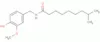
CAS 19408-84-5
:dihydrocapsaicin
Description:
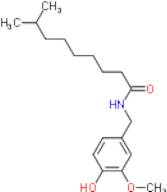
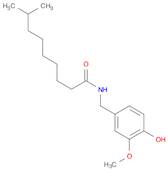
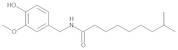
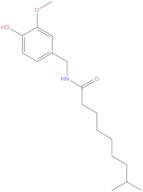
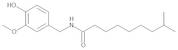
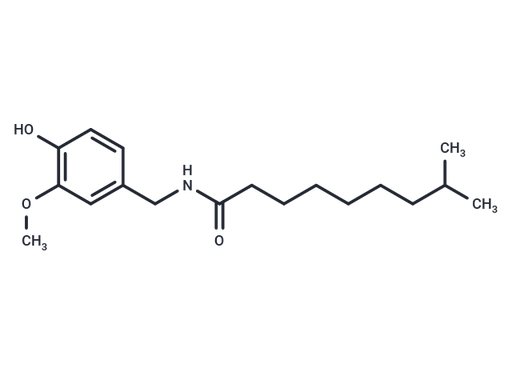
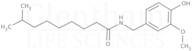
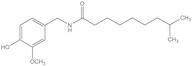
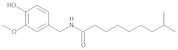
Dihydrocapsaicin is a chemical compound classified as a capsaicinoid, which is primarily found in chili peppers. It is known for its pungent flavor and is responsible for the heat sensation associated with spicy foods. Dihydrocapsaicin has a molecular formula of C18H27NO3 and features a long hydrophobic carbon chain, contributing to its lipophilic nature. This compound exhibits a high degree of solubility in organic solvents but is less soluble in water. Its structure includes an amide functional group, which is characteristic of capsaicinoids. Dihydrocapsaicin is often studied for its potential health benefits, including analgesic properties and its role in metabolism. Additionally, it is used in various applications, such as food flavoring and topical analgesics. The compound's pungency is measured using the Scoville scale, where it ranks among the hotter capsaicinoids, although it is less potent than capsaicin itself. Overall, dihydrocapsaicin is a significant compound in both culinary and medicinal contexts, contributing to the unique characteristics of spicy foods.
Formula:C18H29NO3
InChI:InChI=1/C18H29NO3/c1-14(2)8-6-4-5-7-9-18(21)19-13-15-10-11-16(20)17(12-15)22-3/h10-12,14,20H,4-9,13H2,1-3H3,(H,19,21)
InChI key:InChIKey=XJQPQKLURWNAAH-UHFFFAOYSA-N
SMILES:C(NC(CCCCCCC(C)C)=O)C1=CC(OC)=C(O)C=C1
Synonyms:- 6,7-Dihydrocapsaicin
- 8-methyl-N-vanillylnonanamide
- Capsaicin, dihydro-
- N-(4-hydroxy-3-methoxybenzyl)-8-methylnonanamide
- N-[(4-Hydroxy-3-methoxyphenyl)methyl]-8-methylnonanamide
- Nonanamide, 8-methyl-N-vanillyl-
- Nonanamide, N-[(4-hydroxy-3-methoxyphenyl)methyl]-8-methyl-
- Dihydrocapsaicin
- 8-METHYL-N-VANILLYL-6-NONENEAMIDE
- 8-METHYL-N-VANILLYL-TRANS-6-NONENAMIDE
- FEMA 2787
- (E)-N-[(4-HYDROXY-3-METHOXYPHENYL)METHYL]-8-METHYL-6-NONENAMIDE
- (E)-N-([4-HYDROXY-3-METHOXYPHENYL]METHYL)8-METHYL-6-NONEAMIDE
- 8-METHYL-N-VANILLYLNONANAMIDE APPROX.*90 % FROM CAPS
- FEMA 3404
- 8-methyl-N-vanillylnonanamide approx.*90% from ca
- (E)-8-METHYL-NON-6-ENOIC ACID 4-HYDROXY-3-METHOXY-BENZYLAMIDE
- CAPSAICINE
- N-[(4-HYDROXY-3-METHOXYPHENYL)METHYL]-8-METHYL-6E-NONENAMIDE
- N-[(4-HYDROXY-3-METHOXYPHENYL)METHYL]-8-METHYL-6-NONENAMIDE
- (E)-CAPSAICIN
- (e)-8-methyl-n-vanillyl-6-nonenamide
- 8-METHYL-N-VANILLYL-6-NONENAMIDE
- 8-methyl-n-vanillyl-nonanamid
- CAPSAICIN
- TRANS-8-METHYL-N-VANILLYL-6-NONENAMIDE
- See more synonyms
Sort by
Purity (%)
0
100
|
0
|
50
|
90
|
95
|
100
Dihydrocapsaicin
CAS:Cyclic amides and their derivatives, nesoiFormula:C18H29NO3Color and Shape:White Off-White PowderMolecular weight:307.21474N-(4-Hydroxy-3-Methoxybenzyl)-8-Methylnonanamide
CAS:N-(4-Hydroxy-3-Methoxybenzyl)-8-MethylnonanamideFormula:C18H29NO3Purity:98%Molecular weight:307.43N-(4-Hydroxy-3-Methoxybenzyl)-8-Methylnonanamide
CAS:Formula:C18H29NO3Purity:98%Color and Shape:SolidMolecular weight:307.4278Dihydrocapsaicin
CAS:DihydrocapsaicinFormula:C18H29NO3Purity:≥95%Color and Shape:SolidMolecular weight:307.43Dihydrocapsaicin (Standard)
CAS:Dihydrocapsaicin (Standard) is a reference standard for research and analysis in studies involving Dihydrocapsaicin. Dihydrocapsaicin (CCRIS1589) is isolated from Capsicum fruit. Capsaicin is the primary active component of the heat and pain-eliciting lipid soluble fraction of the Capsicum pepper. Like capsaicin, dihydrocapsaicin is an irritant. Capsaicin is found in natural hot pepper extracts along with a number of impurities, including dihydrocapsaicin and several lesser impurities. Separation by HPLC is required in order to obtain pure dihydrocapsaicin. Dihydrocapsaicin represents about 10% of the compound present in commercial preparations purporting to be pure capsaicin, but it has about the same pungency as capsaicin. VR1 (vanilloid receptor 1) is a heat activated calcium ion channel which functions as a part of the normal nociceptive pain pathway. Capsaicin elicits a sensation of burning pain by activation of VR1 on small, non-myelinated polymodal C-type nociceptive nerve fibers. The potency of dihydrocapsaicin at VR1 appears equivalent to capsaicin. Antioxidant. Reduces oxidation of serum lipids. Mutagenic. Dihydrocapsaicin is an activator of VR1.Formula:C18H29NO3Molecular weight:307.43Dihydrocapsaicin
CAS:Dihydrocapsaicin analytical standard provided with chromatographic purity, to be used as reference material for qualitative determination.Formula:C18H29NO3Purity:(HPLC) ≥85%Color and Shape:PowderMolecular weight:307.44Dihydrocapsaicin
CAS:Formula:C18H29NO3Purity:>98.0%(HPLC)(qNMR)Color and Shape:White to Light yellow powder to crystalMolecular weight:307.43Dihydrocapsaicin
CAS:Dihydrocapsaicin, similar to capsaicin, is an irritant found in Capsicum, used in "pure" capsaicin products at about 10%, activates VR1, and is an antioxidant.Formula:C18H29NO3Purity:99.8% - ≥95%Color and Shape:White CrystalMolecular weight:307.43Dihydrocapsaicin
CAS:Formula:C18H29NO3Purity:≥ 97.0%Color and Shape:White to off-white powderMolecular weight:307.43Dihydrocapsaicin
CAS:N-(4-Hydroxy-3-methoxybenzyl)-8-methylnonanamideFormula:C18H29NO3Purity:98%Molecular weight:307.43Dihydrocapsaicin
CAS:Natural alkaloidFormula:C18H29NO3Purity:≥ 95.0 % (HPLC)Color and Shape:PowderMolecular weight:307.43Dihydro Capsaicin
CAS:Controlled ProductApplications Capsaicin (C175680) analog. A VR1 vaniloid receptor agonist.
Not a dangerous good if item is equal to or less than 1g/ml and there is less than 100g/ml in the package
References Ralevic, V., et al.: Biochem. Pharmacol., 65, 143 (2003), Thompson, R., et al.: Anal. Bioanal. Chem., 381, 1432 (2005), Tuoya., et al.: Life Sci., 78, 1515 (2006),Formula:C18H29NO3Color and Shape:NeatMolecular weight:307.43