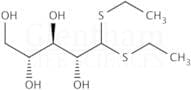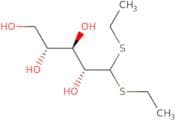
CAS 1941-50-0
:D-ARABINOSE DIETHYLDITHIOACETAL
Description:
D-Arabinose diethyldithioacetal is a chemical compound characterized by its unique structure, which includes a dithioacetal functional group. This compound is derived from D-arabinose, a five-carbon aldopentose sugar, and features two ethyl dithioacetal groups that enhance its stability and reactivity. It is typically used in organic synthesis, particularly in the protection of carbonyl groups during chemical reactions. The presence of the dithioacetal moiety allows for selective reactions, making it valuable in the synthesis of more complex molecules. D-Arabinose diethyldithioacetal is generally a colorless to pale yellow liquid, and it is soluble in organic solvents. Its reactivity can be influenced by the conditions under which it is used, including temperature and the presence of catalysts. Safety precautions should be taken when handling this compound, as with many organosulfur compounds, due to potential toxicity and reactivity. Overall, D-arabinose diethyldithioacetal serves as an important intermediate in carbohydrate chemistry and synthetic organic chemistry.
Formula:C9H20O4S2
InChI:InChI=1/C9H20O4S2/c1-3-14-9(15-4-2)8(13)7(12)6(11)5-10/h6-13H,3-5H2,1-2H3
SMILES:CCSC(C(C(C(CO)O)O)O)SCC
Synonyms:- Ribose Dithioethyl Acetal
Sort by
Purity (%)
0
100
|
0
|
50
|
90
|
95
|
100
Found 2 products.
D-Arabinose diethyldithioacetal
CAS:D-Arabinose diethyldithioacetal is a nitro compound that is used as an anticoagulant. It has a high degree of water solubility and can be administered intravenously. D-Arabinose diethyldithioacetal is formed from d-arabinose and diethyl dithiocarbamate by reaction with boron trifluoride etherate in the presence of hydrochloric acid. This produces the nitro group, which can then react with a hydroxymethyl group to form the final product. The reaction proceeds through two steps: first, the hydroxy methyl group converts to a trifluoroacetic acid derivative, followed by addition of nitric acid to produce the desired product. The final product contains two benzyl groups and two functional groups, which are responsible for its anticoagulant properties.Formula:C9H20O4S2Purity:Min. 95%Color and Shape:Off-white solid.Molecular weight:256.38 g/mol