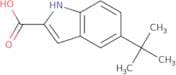
CAS 194490-19-2
:5-(1,1-Dimethylethyl)-1H-indole-2-carboxylic acid
Description:
5-(1,1-Dimethylethyl)-1H-indole-2-carboxylic acid, with the CAS number 194490-19-2, is an organic compound characterized by its indole structure, which is a bicyclic compound consisting of a benzene ring fused to a pyrrole ring. This compound features a carboxylic acid functional group (-COOH) at the 2-position of the indole ring, contributing to its acidic properties. The presence of a tert-butyl group (1,1-dimethylethyl) at the 5-position enhances its lipophilicity, potentially influencing its biological activity and solubility in organic solvents. The compound may exhibit various chemical reactivity patterns typical of indole derivatives, including electrophilic substitution and hydrogen bonding due to the carboxylic acid group. It is of interest in medicinal chemistry and research due to its potential applications in pharmaceuticals and as a building block in organic synthesis. Safety and handling considerations should be observed, as with any chemical substance, particularly regarding its reactivity and potential toxicity.
Formula:C13H15NO2
InChI:InChI=1S/C13H15NO2/c1-13(2,3)9-4-5-10-8(6-9)7-11(14-10)12(15)16/h4-7,14H,1-3H3,(H,15,16)
InChI key:InChIKey=FDPUFZBJUZPCRB-UHFFFAOYSA-N
SMILES:C(C)(C)(C)C=1C=C2C(NC(C(O)=O)=C2)=CC1
Synonyms:- 5-(1,1-Dimethylethyl)-1H-indole-2-carboxylic acid
- 1H-Indole-2-carboxylic acid, 5-(1,1-dimethylethyl)-
Sort by
Purity (%)
0
100
|
0
|
50
|
90
|
95
|
100
Found 1 products.
5-tert-Butyl-1H-indole-2-carboxylic acid
CAS:5-tert-Butyl-1H-indole-2-carboxylic acid is an acidic, carboxylic acid that is synthesized from indole and benzene. It has a moiety of substituents on the phenyl ring. 5-tert-Butyl-1H-indole-2-carboxylic acid is synthesised by reacting indole with benzene in the presence of trifluoroacetic acid and sodium hydroxide. This reaction yields 5-(benzoyloxy)indole and 5-(benzoyloxy)indole carboxylic acid. The carboxylic acid can be obtained as a white solid that is soluble in water, ethanol, and ether. The brain membranes contain high concentrations of this compound, which can be used to study its function as a neurotransmitter or neuromodulator.Formula:C13H15NO2Purity:Min. 95%Molecular weight:217.26 g/mol