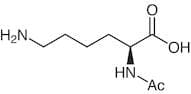
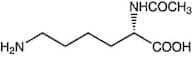
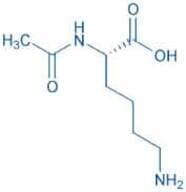
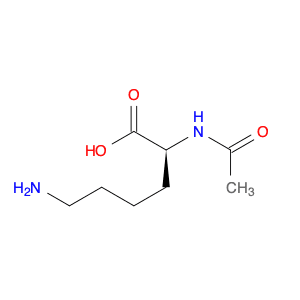
CAS 1946-82-3
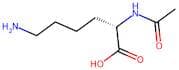
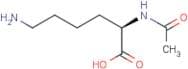
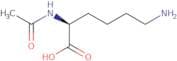
:N-Acetyl-L-lysine
Description:
N-Acetyl-L-lysine is a derivative of the amino acid L-lysine, characterized by the addition of an acetyl group to the amino group of lysine. This modification enhances its solubility in water and alters its biological activity. The molecular formula of N-Acetyl-L-lysine is C₆H₁₄N₂O₂, and it has a molecular weight that reflects its composition of carbon, hydrogen, nitrogen, and oxygen. This compound is often utilized in biochemical research and has potential applications in nutrition and pharmaceuticals, particularly in studies related to protein synthesis and metabolism. N-Acetyl-L-lysine is known to play a role in various physiological processes, including acting as a precursor for the synthesis of acetylated proteins. It is generally considered safe for use in dietary supplements and research applications. As with many amino acid derivatives, it is important to handle N-Acetyl-L-lysine with care, following appropriate safety protocols to ensure proper usage in laboratory settings.
Formula:C8H16N2O3
InChI:InChI=1S/C8H16N2O3/c1-6(11)10-7(8(12)13)4-2-3-5-9/h7H,2-5,9H2,1H3,(H,10,11)(H,12,13)/t7-/m0/s1
InChI key:InChIKey=VEYYWZRYIYDQJM-ZETCQYMHSA-N
SMILES:[C@@H](CCCCN)(NC(C)=O)C(O)=O
Synonyms:- (2S)-2-Acetamido-6-aminohexanoic acid
- (2S)-6-Amino-2-acetamidohexanoic acid
- 6-Amino-<span class="text-smallcaps">L</span>-2-acetamidohexanoic acid
- <span class="text-smallcaps">L</span>-Lysine, N<sup>2</sup>-acetyl-
- Ac-Lys-Oh
- Lysine, N<sup>2</sup>-acetyl-, <span class="text-smallcaps">L</span>-
- N(alpha)-Acetyllysine
- N-Acetyl-<span class="text-smallcaps">L</span>-lysine
- N-acetyl-L-lysine
- N-alpha-Acetyl-L-lysine
- N<sup>2</sup>-Acetyl-<span class="text-smallcaps">L</span>-lysine
- N<sup>2</sup>-Acetyllysine
- N<sup>α</sup>-Acetyl-<span class="text-smallcaps">L</span>-lysine
- N<sup>α</sup>-Acetyllysine
- N~2~-acetyl-L-lysine
- Nα-Acetyl-L-lysine
- Lysine, N2-acetyl-, L-
- Nα-Acetyllysine
- N2-Acetyl-L-lysine
- See more synonyms
Sort by
Purity (%)
0
100
|
0
|
50
|
90
|
95
|
100
Found 12 products.
Nα-Acetyl-L-lysine
CAS:Formula:C8H16N2O3Purity:>97.0%(T)(HPLC)Color and Shape:White to Almost white powder to crystalineMolecular weight:188.23N(α)-Acetyl-L-lysine, 99%
CAS:N-Acetyl-L-lysine is a biologically available N-terminal capped form of the proteinogenic amino acid L-lysine. N-Acetyl-L-lysine is a substrate used to study and characterize lysyl oxidize(s). This Thermo Scientific Chemicals brand product was originally part of the Alfa Aesar product portfolio. SoFormula:C8H16N2O3Purity:99%Molecular weight:188.2Ac-Lys-OH
CAS:Bachem ID: 4000486.
Formula:C8H16N2O3Purity:≥99%Color and Shape:White PowderMolecular weight:188.23Acetyl-L-lysine
CAS:Acetyl-L-lysine: N-acetylated amino acid, normally found in trace urine amounts, elevated in aminoacylase I deficiency.Formula:C8H16N2O3Purity:99.40% - 99.83%Color and Shape:SolidMolecular weight:188.22Nalpha-Acetyl-L-Lysine
CAS:Applications Nα-Acetyl-L-Lysine is an antibacterial lysine analogue that targets lysine riboswitches. Nα-Acetyl-L-Lysine is used in the metabolomic characterization of ovarian epithelial carcinomas which allows for better therapeutic management of patients. The presence of Nα-Acetyl-L-Lysine and other N-acetylated amino acids in the urine can be used to detect aminoacylase I deficiency.
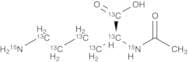
References Gerlo, E. et al.: Anal. Chim. Acta, 571, 191 (2006); Ben Sellem, D. et al.: J. Oncol., 174019, 9 (2011); Blount, K.F. et al.: Nat. Chem. Biol., 3, 44 (2007);Formula:C8H16N2O3Color and Shape:NeatMolecular weight:188.22Nα-Acetyl-L-Lysine-13C6,15N2
CAS:Controlled ProductFormula:C6C2H1615N2O3Color and Shape:NeatMolecular weight:196.167N-α-Acetyl-L-lysine
CAS:N-alpha-Acetyl-L-lysine is a reactive chemical that is used as an analytical method to measure the amount of aminotransferase activity in tissue samples. It reacts with the enzyme and produces a characteristic color change that can be quantified. This compound has been shown to cause lung damage in rats after inhalation and has been studied as a model system for bronchiolitis obliterans, which is caused by exposure to sulfur dioxide gas. N-alpha-Acetyl-L-lysine also binds to monoclonal antibody, which may lead to inhibition of protein synthesis. Titration calorimetry experiments have revealed a reaction mechanism for this compound involving the formation of a hydroxyl group from acetaldehyde via an intermediate hydroxide ion.Formula:C8H16N2O3Purity:Min. 95%Molecular weight:188.22 g/mol