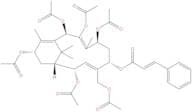
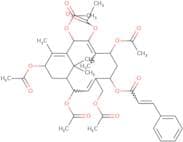
CAS 194782-02-0
:2-Propenoic acid,3-phenyl-,(1R,2S,5S,7S,10R,13S)-2,7,9,10,13-pentakis(acetyloxy)-4-[(acetyloxy)methyl]-8,12,15,15-tetramethylbicyclo[9.3.1]pentadeca-3,8,11-trien-5-ylester, (2E)-
Description:
The chemical substance known as 2-Propenoic acid, 3-phenyl-, with the specified stereochemistry and complex structure, is a derivative of acrylic acid featuring a phenyl group and multiple acetyloxy substituents. This compound belongs to a class of organic molecules characterized by its bicyclic structure, which contributes to its unique reactivity and potential applications in organic synthesis and materials science. The presence of multiple acetyloxy groups suggests that it may exhibit interesting properties such as enhanced solubility and reactivity, making it suitable for various chemical reactions, including esterification and polymerization. The stereochemistry indicated by the (1R,2S,5S,7S,10R,13S) configuration implies that the compound has specific spatial arrangements that can influence its biological activity and interaction with other molecules. Overall, this compound's intricate structure and functional groups may provide avenues for research in medicinal chemistry, polymer development, and other fields where tailored chemical properties are desired.
Formula:C41H50O14
Synonyms:- 2-Propenoicacid, 3-phenyl-,(1R,2S,3E,5S,7S,8E,10R,13S)-2,7,9,10,13-pentakis(acetyloxy)-4-[(acetyloxy)methyl]-8,12,15,15-tetramethylbicyclo[9.3.1]pentadeca-3,8,11-trien-5-ylester, (2E)- (9CI)
- 2-Propenoic acid, 3-phenyl-, 2,7,9,10,13-pentakis(acetyloxy)-4-[(acetyloxy)methyl]-8,12,15,15-tetramethylbicyclo[9.3.1]pentadeca-3,8,11-trien-5-ylester, [1R-[1R*,2S*,3E,5S*(E),7S*,8E,10R*,13S*]]-
- Taxuspin X
- Taxuspine X
Sort by
Purity (%)
0
100
|
0
|
50
|
90
|
95
|
100
Found 3 products.
Taxuspine X
CAS:Taxuspine X may have p-glycoprotein inhibitory activity.Formula:C41H50O14Purity:98%Color and Shape:SolidMolecular weight:766.83Taxuspine X
CAS:Taxuspine X is an alkaloidal extract derived from the European yew, Taxus baccata, which is a coniferous tree native to Europe. This product acts primarily through its ability to modulate neural pathways, providing neuroprotective effects. It works by inhibiting the activity of certain enzymes that contribute to neurodegenerative processes, thus promoting neuronal survival and functionality.Formula:C41H50O14Purity:Min. 95%Molecular weight:766.8 g/mol