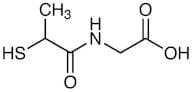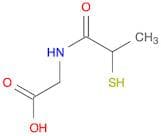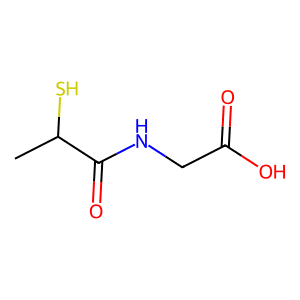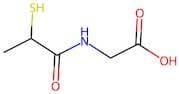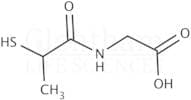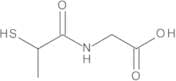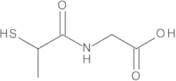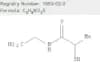
CAS 1953-02-2
:Tiopronin
Description:
Tiopronin, with the CAS number 1953-02-2, is a synthetic thiol compound primarily used as a medication for the treatment of cystinuria, a genetic disorder that leads to the formation of cystine stones in the kidneys. It acts as a cystine-binding agent, promoting the solubility of cystine in urine and thereby reducing stone formation. Tiopronin is characterized by its ability to form mixed disulfides with cysteine, which enhances the excretion of cystine. The compound is typically administered orally and is known for its relatively low toxicity profile. In addition to its therapeutic uses, tiopronin has been studied for its potential antioxidant properties due to the presence of the thiol group, which can scavenge free radicals. Its chemical structure includes a thiol functional group, contributing to its reactivity and biological activity. Overall, tiopronin is an important agent in managing cystinuria and has implications in broader biochemical research related to thiol chemistry.
Formula:C5H9NO3S
InChI:InChI=1S/C5H9NO3S/c1-3(10)5(9)6-2-4(7)8/h3,10H,2H2,1H3,(H,6,9)(H,7,8)
InChI key:InChIKey=YTGJWQPHMWSCST-UHFFFAOYSA-N
SMILES:C(NCC(O)=O)(C(C)S)=O
Synonyms:- (.+-.)-Tiopronin
- (2-Mercaptopropionamido)acetic acid
- (2-Mercaptopropionyl)glycine
- 2-(2-Sulfanylpropanamido)acetic acid
- 2-(2-Sulfanylpropanoylamino)acetic acid
- <span class="text-smallcaps">DL</span>-(α-Mercaptopropionyl)glycine
- Acadione
- Brn 1859822
- Capen
- Captimer
- Ccris 1935
- DL-(α-Mercaptopropionyl)glycine
- Epatiol
- Glycine, N-(2-mercaptopropionyl)-
- Hepadigest
- MPG
- MPG (hepatoprotective)
- Meprin
- Meprin (detoxicant)
- Mercaptopropionylglycine
- Mucolysin
- N-(2-Mercapto-1-oxopropyl)glycine
- N-(2-Mercaptopropionyl)glycine
- N-(α-Mercaptopropionyl) glycine
- Sutilan
- Sutilan Cusi
- Thiola
- Thiolpropionamidoacetic acid
- Thiopronin
- Thiopronine
- Thiosol
- Tioglis
- Tiopronine
- Tiopronino
- Tioproninum
- Vincol
- α-Mercaptopropionyglycine
- α-Mercaptopropionylglycine
- See more synonyms
Sort by
Purity (%)
0
100
|
0
|
50
|
90
|
95
|
100
Found 12 products.
Tiopronin
CAS:Formula:C5H9NO3SPurity:>97.0%(GC)(T)Color and Shape:White to Almost white powder to crystalMolecular weight:163.192-(2-sulfanylpropanamido)acetic acid
CAS:Formula:C5H9NO3SPurity:98%Color and Shape:SolidMolecular weight:163.1949Tiopronin
CAS:Tiopronin (Acadione), a sulfhydryl acylated derivative of glycine, leads to a reduction in urinary cystine concentration and subsequently reduces cystine stoneFormula:C5H9NO3SPurity:97.19% - 98%Color and Shape:SolidMolecular weight:163.19Tiopronin
CAS:Controlled ProductApplications It is used as antidote against heavy metal poisoning; hepatoprotectant; mucolytic.
References Capasso, F., et al.: Agents Actions, 11, 741 (1981), Amor, B., et al.: Arthritis Rheum., 25, 698 (1982), Ichida, F., et al.: J. Int. Med. Res., 10, 325 (1982),Formula:C5H9NO3SColor and Shape:NeatMolecular weight:163.19Tiopronin
CAS:Tiopronin is a drug that binds to the GSH-Px enzyme, which is responsible for breaking down hydrogen peroxide and lipid hydroperoxides. It also inhibits the ATP-binding cassette transporter, which is an important protein in the cell membrane that regulates the passage of substances into and out of cells. Tiopronin has been shown to inhibit chemiluminescence reactions in bacteria, such as infectious diseases. This drug has also been shown to be effective against hepatic steatosis by reducing fatty acid synthesis and increasing fatty acid oxidation in rats. Tiopronin has been used for the treatment of patients with Wilson's disease, because it facilitates copper excretion from liver cells by inhibiting metal chelate formation.Formula:C5H9NO3SPurity:Min. 95%Color and Shape:PowderMolecular weight:163.2 g/mol