CAS 19689-97-5
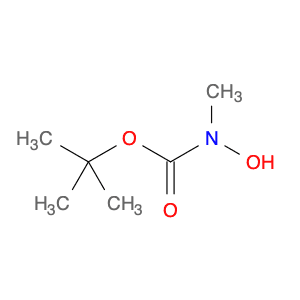
:tert-butyl hydroxy(methyl)carbamate
Description:
Tert-butyl hydroxy(methyl)carbamate, with the CAS number 19689-97-5, is an organic compound that belongs to the class of carbamates. It is characterized by the presence of a tert-butyl group, which contributes to its steric bulk and hydrophobic properties. The compound features a hydroxy group and a methyl group attached to the carbamate functional group, which enhances its reactivity and solubility in various solvents. Tert-butyl hydroxy(methyl)carbamate is often utilized in organic synthesis and as a protecting group in the preparation of amines and other functional groups due to its stability and ease of removal under mild conditions. Its structure allows for potential applications in pharmaceuticals and agrochemicals, where it may serve as an intermediate or a building block in the synthesis of more complex molecules. Safety data should be consulted for handling and storage, as with any chemical substance, to ensure proper precautions are taken.
Formula:C6H13NO3
InChI:InChI=1/C6H13NO3/c1-6(2,3)10-5(8)7(4)9/h9H,1-4H3
SMILES:CC(C)(C)OC(=O)N(C)O
Sort by
Purity (%)
0
100
|
0
|
50
|
90
|
95
|
100
Found 4 products.
Carbamic acid, N-hydroxy-N-methyl-,1,1-dimethylethyl ester
CAS:Formula:C6H13NO3Purity:95%Color and Shape:LiquidMolecular weight:147.1723tert-Butyl hydroxy(methyl)carbamate
CAS:tert-Butyl hydroxy(methyl)carbamatePurity:95%Molecular weight:147.17g/moltert-Butyl hydroxy(methyl)carbamate
CAS:Tert-Butyl hydroxy(methyl)carbamate is a linker that has been used in the synthesis of a number of pharmaceuticals including the anti-inflammatory drug celecoxib. It is an intermediate in the synthesis of several drugs, such as erythromycin, cefuroxime, and amoxicillin. Tert-Butyl hydroxy(methyl)carbamate can be activated to form reactive carbonyl groups by treatment with reagents like diazoethane or oxalyl chloride. These carbonyl groups can then react with nucleophiles like hydroxide ion to produce tert-butyl hydroxy(methyl)carbamate derivatives. Tert-Butyl hydroxy(methyl)carbamate reacts with bacterial cells by binding to purine bases on the ribosome. This binding prevents protein synthesis and cell division, leading to cell death.
Formula:C6H13NO3Purity:Min. 95%Molecular weight:147.17 g/mol