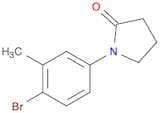
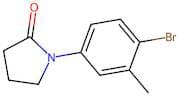
CAS 197450-39-8
:1-(4-bromo-3-methylphenyl)pyrrolidin-2-one
Description:
1-(4-bromo-3-methylphenyl)pyrrolidin-2-one, with the CAS number 197450-39-8, is a chemical compound characterized by its unique structure, which includes a pyrrolidinone ring and a substituted phenyl group. The presence of a bromine atom and a methyl group on the phenyl ring contributes to its chemical reactivity and potential biological activity. This compound is typically classified as a heterocyclic organic compound due to the inclusion of nitrogen in the ring structure. It may exhibit properties such as moderate solubility in organic solvents and potential interactions with biological systems, making it of interest in medicinal chemistry and drug development. The bromine substitution can influence the compound's electronic properties and steric effects, which may affect its pharmacological profile. As with many organic compounds, safety and handling precautions are essential, as it may pose risks depending on its specific use and exposure levels. Further studies would be necessary to fully elucidate its properties and potential applications.
Formula:C11H12BrNO
Synonyms:- 2-Pyrrolidinone, 1-(4-bromo-3-methylphenyl)-
- SKL554
- 1-(4-Bromo-3-methylphenyl)-2-pyrrolidone
- 1-(4-bromo-3-methylphenyl)pyrrolidin-2-one
Sort by
Purity (%)
0
100
|
0
|
50
|
90
|
95
|
100
Found 3 products.
1-(4-Bromo-3-methylphenyl)-2-pyrrolidone
CAS:1-(4-Bromo-3-methylphenyl)-2-pyrrolidonePurity:95%Molecular weight:254.13g/mol1-(4-Bromo-3-methylphenyl)pyrrolidin-2-one
CAS:1-(4-Bromo-3-methylphenyl)pyrrolidin-2-one is a biphenyl derivative that is used in organic process research. It has been shown to be efficient as a catalyst for the carboxylation of phenols and amides with chlorides or cyclised biphenylcarboxylic acids, or for the coupling of 4-carboxyphenylboronic acid with carboxylic acids. The optimisation of the reaction conditions was achieved by using a Suzuki coupling reaction with a palladium catalyst.Formula:C11H12BrNOPurity:Min. 95%Molecular weight:254.12 g/mol