CAS 19804-27-4
:4-Methyldiphenhydramine
Description:
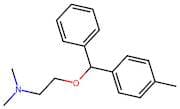
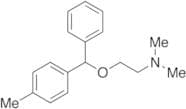
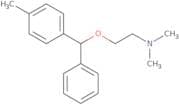
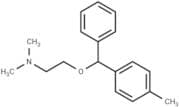
4-Methyldiphenhydramine is an antihistamine belonging to the diphenhydramine class, primarily used for its sedative and anti-allergic properties. It is characterized by its chemical structure, which includes two phenyl rings and a methyl group attached to the nitrogen atom of the diphenhydramine backbone. This modification enhances its pharmacological effects and alters its potency and side effect profile compared to its parent compound. The substance is typically a white to off-white crystalline powder, exhibiting low solubility in water but higher solubility in organic solvents. Its mechanism of action involves antagonism of the H1 histamine receptor, which helps alleviate symptoms of allergic reactions, such as itching and runny nose. Additionally, due to its sedative effects, it is sometimes used in over-the-counter sleep aids. Safety and efficacy profiles are important considerations, as with any medication, and potential side effects may include drowsiness, dry mouth, and dizziness. As with all pharmaceuticals, proper dosage and medical guidance are essential for safe use.
Formula:C18H23NO
InChI:InChI=1S/C18H23NO/c1-15-9-11-17(12-10-15)18(20-14-13-19(2)3)16-7-5-4-6-8-16/h4-12,18H,13-14H2,1-3H3
InChI key:InChIKey=PJUYQWIDNIAHIZ-UHFFFAOYSA-N
SMILES:C(OCCN(C)C)(C1=CC=C(C)C=C1)C2=CC=CC=C2
Synonyms:- 2-((p-Methyl-alpha-phenylbenzyl)oxy)ethyl(dimethyl)amine
- 4-Methyldiphenhydramine
- Ethanamine, N,N-dimethyl-2-[(4-methylphenyl)phenylmethoxy]-
- Ethylamine, N,N-dimethyl-2-[(p-methyl-α-phenylbenzyl)oxy]-
- N,N-Dimethyl-2-[(4-methylphenyl)phenylmethoxy]ethanamine
- N,N-Dimethyl-N-[2-(p-methyl-α-phenylbenzyloxy)ethyl]amine
- N,N-dimethyl-2-[(4-methylphenyl)(phenyl)methoxy]ethanamine
- Toladryl
- p-Methylbenzhydryl 2-dimethylaminoethyl ether
- p-Methyldiphenhydramine
Sort by
Purity (%)
0
100
|
0
|
50
|
90
|
95
|
100
Found 9 products.
Orphenadrine Related Compound F (N,N-Dimethyl-2-[phenyl(p-tolyl)methoxy]ethanamine citrate)
CAS:Amino-alcohols, other than those containing more than one kind of oxygen function, their ethers and esters, salts thereof, nesoiFormula:C18H23NO·C6H8O7Color and Shape:White PowderMolecular weight:461.5Ethanamine, N,N-dimethyl-2-[(4-methylphenyl)phenylmethoxy]-
CAS:Formula:C18H23NOPurity:98%Color and Shape:LiquidMolecular weight:269.3813N,N-Dimethyl-2-(phenyl(p-tolyl)methoxy)ethanamine
CAS:N,N-Dimethyl-2-(phenyl(p-tolyl)methoxy)ethanaminePurity:98%Molecular weight:269.39g/molToladryl (Diphenhydramine EP Impurity B, Dimenhydrinate EP Impurity G, Orphenadrine EP Impurity F, Orphenadrine USP Related Compound F (Free Form))
CAS:Formula:C18H23NOMolecular weight:269.39Toladryl
CAS:Controlled ProductApplications A diphenhydramine (D486900) analog classified as an antihistaminic.
References Bakker, R.A. et al.: Mol. Pharm., 60, 1133 (2001); Rekker, R.F. et al.: Arzneim.-Forsch., 21, 688 (1971);Formula:C18H23NOColor and Shape:NeatMolecular weight:269.38Toladryl
CAS:Controlled ProductToladryl is a histamine receptor antagonist used to treat allergies and hay fever. It blocks the H1 histamine receptors in the body, preventing them from binding with histamine and causing allergic reactions. Toladryl also has a role in lowering blood pressure by blocking the alpha-1 adrenergic receptors, which are responsible for vasoconstriction. This drug is an aziridine derivative that has been synthesized using an asymmetric synthesis process. It has been shown to be effective in spastic conditions, such as multiple sclerosis, because it inhibits the transfer of potassium ions across nerve cells.Formula:C18H23NOPurity:Min. 95%Molecular weight:269.38 g/molToladryl
CAS:Toladryl is a derivative of Diphenhydramine that can cross the blood-brain barrier and exhibits oral activity, with antihistamine and anticholinergic properties. Its anticholinergic effects are approximately a tenth of those seen with Diphenhydramine, yet it offers 2-4 times the protection against lethal doses of histamine in guinea pigs. The side effects of Toladryl are fewer and milder compared to Diphenhydramine; however, at higher doses, it may cause symptoms such as insomnia, agitation, and disorientation related to the central nervous system. Toladryl is utilized in the research of allergic diseases.Formula:C18H23NOColor and Shape:SolidMolecular weight:269.38


![Ethanamine, N,N-dimethyl-2-[(4-methylphenyl)phenylmethoxy]-](/_next/image/?url=https%3A%2Fstatic.cymitquimica.com%2Fproducts%2FIN%2Fthumb%2FDA002B92.jpg&w=3840&q=75)