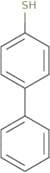
CAS 19813-90-2
:biphenyl-4-thiol
Description:
Biphenyl-4-thiol, also known as 4-biphenylthiol, is an organic compound characterized by the presence of a thiol (-SH) functional group attached to one of the phenyl rings in a biphenyl structure. Its molecular formula is C12H10S, indicating it consists of twelve carbon atoms, ten hydrogen atoms, and one sulfur atom. This compound typically appears as a colorless to pale yellow liquid or solid, depending on the temperature and purity. Biphenyl-4-thiol is known for its aromatic properties, which contribute to its stability and reactivity. It is often used in organic synthesis and as a building block in the production of various chemical compounds, including pharmaceuticals and agrochemicals. Additionally, it can serve as a ligand in coordination chemistry and has applications in materials science due to its potential in forming self-assembled monolayers. Safety precautions should be observed when handling this compound, as thiols can be malodorous and may pose health risks upon exposure.
Formula:C12H10S
InChI:InChI=1/C12H10S/c13-12-8-6-11(7-9-12)10-4-2-1-3-5-10/h1-9,13H
SMILES:c1ccc(cc1)c1ccc(cc1)S
Synonyms:- [1,1'-Biphenyl]-4-thiol
Sort by
Purity (%)
0
100
|
0
|
50
|
90
|
95
|
100
Found 4 products.
Biphenyl-4-thiol
CAS:Biphenyl-4-thiol is a biphenyl derivative that is used in the treatment of fatty acid oxidation disorders. It is a lipophilic molecule that accumulates in red blood cells and can be detected by surface-enhanced Raman spectroscopy. Biphenyl-4-thiol has been shown to interact with the lipid bilayer, which may be due to its ability to form monolayers on the surface of red blood cells. The dipole moment of biphenyl-4-thiol causes an accumulation of electrons on one side of the molecule, which leads to electrochemical impedance changes upon exposure to electromagnetic radiation. X-ray absorption studies have shown that biphenyl-4-thiol has good chemical stability, which may be due to its aromaticity.
Formula:C12H10SPurity:Min. 95%Molecular weight:186.27 g/mol
![[1,1'-Biphenyl]-4-thiol](/_next/image/?url=https%3A%2Fstatic.cymitquimica.com%2Fproducts%2FIN%2Fthumb%2FDA002BAT.jpg&w=3840&q=75)

![[1,1'-Biphenyl]-4-thiol](/_next/image/?url=https%3A%2Fstatic.cymitquimica.com%2Fproducts%2F54%2Fthumb%2FOR1046635.jpg&w=3840&q=75)