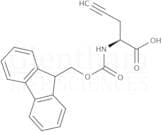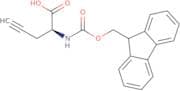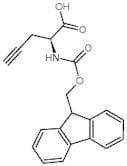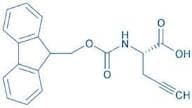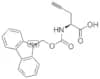
CAS 198561-07-8
:FMOC-L-PROPARGYLGLYCINE
- (2R)-2-{[(9H-fluoren-9-ylmethoxy)carbonyl]amino}pent-4-ynoic acid
- (2S)-2-(9H-Fluoren-9-ylmethoxycarbonylamino)pent-4-ynoic acid
- (2S)-2-[[(9H-Fluoren-9-ylmethoxy)carbonyl]amino]-4-pentynoic acid
- (2S)-2-{[(9H-fluoren-9-ylmethoxy)carbonyl]amino}pent-4-ynoic acid
- (S)-2-(Fmoc-Amino)-4-Pentynoic Acid
- 4-Pentynoic acid, 2-[[(9H-fluoren-9-ylmethoxy)carbonyl]amino]-, (2S)-
- 4-Pentynoic acid, 2-[[(9H-fluoren-9-ylmethoxy)carbonyl]amino]-, (S)-
- Fmoc-(S)-2-Propargylglycine
- Fmoc-<span class="text-smallcaps">L</span>-propargylglycine
- Fmoc-Pra-Oh
- N-Alpha-(9-Fluorenylmethoxycarbonyl)-(S)-2-Amino-4-Pentynoic Acid
- N-Alpha-(9-Fluorenylmethoxycarbonyl)-Propargylglycine
- N-Alpha-(9-Fluorenylmethyloxycarbonyl)-L-Propargylglycine
- Rarechem Bk Pt 0257
- Fmoc-L-propargylglycine
- N-[(9H-Fluoren-9-ylmethoxy)carbonyl]-L-propargylglycine>
- FMOC-L-PROPARGYL-GLY-OH
- N-[(9H-Fluoren-9-ylmethoxy)carbonyl]-L-propargylglycine
- (S)-N-FMoc-2-(2'-propynyl)glycine
- (S)-2-(Fmoc-amino)-4-pentynoic acid, Fmoc-L-2-propargylglycine
- Fmoc-Pra-OH Fmoc-Propargylglycine
- N-Fmoc-L-propargylglycine,95%
- (S)-N-(9-FLUORENYLMETHOXYCARBONYL)-2-AMINO-4-PENTYNOIC ACID
- FMOC-GLY(PROPARGYL)-OH
- Fmoc-L-propargylglycine Novabiochem
- Fmoc-L-propargylglycine≥ 99% (HPLC, Chiral purity)
- N-alpha-(9-Fluorenylmethyloxycarbonyl)-L-propargylglycine, (S)-2-(Fmoc-amino)-4-pentynoic acid
- (S)-N-FMOC-PROPARGYLGLYCINE
- 4-Pentynoicacid, 2-[[(9H-fluoren-9-ylmethoxy)carbonyl]amino]-, (2S)-
- N-FMoc-L-propargylglycine, 95%
- N-Fluorenemethoxycarbonyl-L-Propargyl Glycine
- L-2-Propargylglycine, N-FMOC protected
- (S)-2-(((9H-Fluoren-9-yl)methoxy)carbonylamino)pent-4-ynoic acid
- FMOC-L-2-PROPARGYLGLYCINE
- FMoc-Propargyl-Gly-OH, (S)-2-(FMoc-aMino)-4-pentynoic acid
- FMOC-L-PRA-OH
- (S)-N-FMOC-Propargylglycine, 98% ee, 95%
- Fmoc-propargyl-Gly-OH
- (S)-2-(Fmoc-amino)-4-pentynoic
- (9H-Fluoren-9-yl)MethOxy]Carbonyl Pra-OH
- Fmoc-Pra-OH(Fmoc-Propargly-Gly-OH)
- (S)-N-fmoc-Propargylglycine(e.e.)
- See more synonyms
N-[(9H-Fluoren-9-ylmethoxy)carbonyl]-L-propargylglycine
CAS:Formula:C20H17NO4Purity:>98.0%(T)(HPLC)Color and Shape:White to Almost white powder to crystalMolecular weight:335.36Fmoc-L-propargylglycine
CAS:Formula:C20H17NO4Purity:97%Color and Shape:Solid, Crystalline Powder or PowderMolecular weight:335.359N-Fmoc-L-propargylglycine, 95%
CAS:Fmoc-propargyl-Gly-OH is an Fmoc protected glycine derivative useful for solid phase peptide synthesis techniques. This compound could be useful as an unusual amino acid analog to aid in the deconvolution of protein structure and function. N-Fmoc-L-propargylglycine is a non-natural amino acids usedFormula:C20H17NO4Purity:95%Color and Shape:White, PowderMolecular weight:335.364-Pentynoic acid, 2-[[(9H-fluoren-9-ylmethoxy)carbonyl]amino]-, (2S)-
CAS:Formula:C20H17NO4Purity:97%Color and Shape:SolidMolecular weight:335.3533Fmoc-propargyl-Gly-OH
CAS:Formula:C20H17NO4Purity:≥ 98.0%Color and Shape:White to almost white powder or crystalsMolecular weight:335.36L-2-Propargylglycine, N-FMOC protected
CAS:L-2-Propargylglycine, N-FMOC protectedFormula:C20H17NO4Purity:98%Color and Shape: off-white solidMolecular weight:335.35328g/molFmoc-L-propargylglycine
CAS:Fmoc-L-propargylglycine is a cyclic peptide that is synthesized by chemical ligation. It has antiviral, anti-tumor, and anti-inflammatory activities. Fmoc-L-propargylglycine inhibits the growth of cancer cells in vitro. The mechanism of action is not fully understood, but it may involve the inhibition of cellular proliferation and the induction of apoptosis. This compound also inhibits epidermal growth factor (EGF) induced cell proliferation in caco-2 cells.Formula:C20H17NO4Purity:Min. 98 Area-%Color and Shape:White PowderMolecular weight:335.35 g/molFmoc-l-propargylglycine
CAS:Controlled ProductApplications Fmoc-l-propargylglycine has been used to study the bioorthogonal chemical tagging of protein cholesterylation in living cells.
References William P. H., et al., ChemComm., 47, 4081-4083 (2011)Formula:C20H17NO4Color and Shape:NeatMolecular weight:335.35Fmoc-Pra-OH
CAS:Building block for the synthesis of precursor peptides for tritiation, and for “click chemistry”. Pra-containing peptides have been modified by 1,3-dipolar cycloaddition, e.g. with alkyl azides. Peptides containing a Pra residue and an α-azido acid have been cyclized in the presence of CuBr/Na-ascorbate via triazole formation. Educt for the synthesis of Phe-derivatives by rhodium-catalyzed [2+2+2] cycloaddition.Formula:C20H17NO4Purity:99.9%Color and Shape:WhiteMolecular weight:335.36Fmoc-Pra-OH
CAS:Fmoc-Pra-OH is a bioconjugate used in Click Chemistry. Click Chemistry is a chemical reaction that joins two components together by forming an amide bond between the carboxyl group of one component and the amino group on the other component. Fmoc-Pra-OH was synthesized by reacting the epidermal growth factor (EGF) with a cyclic peptide containing an acid moiety, which was conjugated to the azide group of an azidopropargyl linker. This bioconjugate has been shown to have proliferative activity in vitro and structural studies have been performed to understand its reactivity.
Formula:C20H17NO4Purity:Min. 98.0 Area-%Molecular weight:335.36 g/mol
![N-[(9H-Fluoren-9-ylmethoxy)carbonyl]-L-propargylglycine](/_next/image/?url=https%3A%2Fstatic.cymitquimica.com%2Fproducts%2F3B%2Fthumb%2FF0926.jpg&w=3840&q=75)



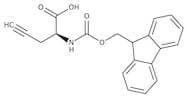

![4-Pentynoic acid, 2-[[(9H-fluoren-9-ylmethoxy)carbonyl]amino]-, (2S)-](/_next/image/?url=https%3A%2Fstatic.cymitquimica.com%2Fproducts%2FIN%2Fthumb%2FDA002BML.jpg&w=3840&q=75)