CAS 1988-11-0
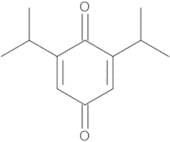
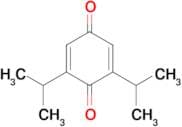
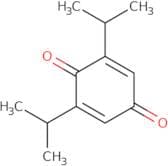
:2,6-Diisopropyl-1,4-benzoquinone
Description:
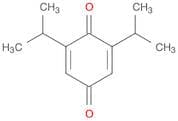
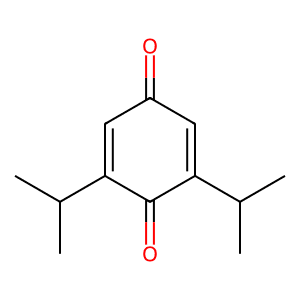
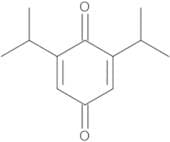
2,6-Diisopropyl-1,4-benzoquinone is an organic compound characterized by its quinone structure, which features a six-membered aromatic ring with two isopropyl groups attached at the 2 and 6 positions. This compound is known for its bright yellow color and is typically used in organic synthesis and as a reagent in various chemical reactions. It exhibits strong oxidizing properties due to the presence of the quinone functional group, which allows it to participate in redox reactions. The compound is relatively stable under standard conditions but can undergo further reactions, such as polymerization or reduction, depending on the environment and reactants present. Its solubility is generally higher in organic solvents than in water, making it suitable for applications in organic chemistry. Additionally, 2,6-Diisopropyl-1,4-benzoquinone may have implications in biological systems, where it can act as an electron acceptor. Safety precautions should be taken when handling this compound, as it may pose health risks if inhaled or ingested.
Formula:C12H16O2
InChI:InChI=1S/C12H16O2/c1-7(2)10-5-9(13)6-11(8(3)4)12(10)14/h5-8H,1-4H3
InChI key:InChIKey=DDXYWFGBQZICBD-UHFFFAOYSA-N
SMILES:C(C)(C)C=1C(=O)C(C(C)C)=CC(=O)C1
Synonyms:- 2,3-Diisopropyl-p-benzoquinone
- 2,5-Cyclohexadiene-1,4-dione, 2,6-bis(1-methylethyl)-
- 2,6-Bis(1-methylethyl)-2,5-cyclohexadiene-1,4-dione
- 2,6-Bis(propan-2-yl)cyclohexa-2,5-diene-1,4-dione
- 2,6-Di(propan-2-yl)cyclohexa-2,5-diene-1,4-dione
- 2,6-Diisopropyl-1,4-benzoquinone
- 2,6-Diisopropyl-p-benzoquinone
- 2,6-Diisopropylcyclohexa-2,5-diene-1,4-dione
- p-Benzoquinone, 2,6-diisopropyl-
Sort by
Purity (%)
0
100
|
0
|
50
|
90
|
95
|
100
Found 11 products.
Propofol impurity J
CAS:Propofol impurity JFormula:C12H16O2Color and Shape:YellowMolecular weight:192.2542Propofol Related Compound B (2,6-Diisopropyl-1,4-benzoquinone)
CAS:Other quinonesFormula:C12H16O2Color and Shape:Yellow LiquidMolecular weight:192.115032,5-Cyclohexadiene-1,4-dione, 2,6-bis(1-methylethyl)-
CAS:Formula:C12H16O2Purity:95%Color and Shape:LiquidMolecular weight:192.25422,6-Diisopropylcyclohexa-2,5-diene-1,4-dione
CAS:2,6-Diisopropylcyclohexa-2,5-diene-1,4-dionePurity:95%Molecular weight:192.26g/mol2,6-Diisopropyl-1,4-benzoquinone
CAS:Impurity Propofol EP Impurity J
Applications 2,6-Diisopropyl-1,4-benzoquinone (Propofol EP Impurity J) is a Propofol (P829750) impurity.
Not a dangerous good if item is equal to or less than 1g/ml and there is less than 100g/ml in the package
References McMahon, R., et al.: J. Med. Chem., 22, 1100 (1979), Mamada, K., et al.: Drug Metab. Dispos., 14, 509 (1986),Formula:C12H16O2Color and Shape:NeatMolecular weight:192.252,6-Diisopropyl-1,4-benzoquinone
CAS:2,6-Diisopropyl-1,4-benzoquinone is a diphenol that reacts with a variety of organic compounds in the presence of heat. It has been used as a mesoporous material to adsorb hydrogen gas and carbon dioxide in the water treatment process. 2,6-Diisopropyl-1,4-benzoquinone is also able to react with oxygen to form an n-oxide. This compound is most often used for the manufacture of phenolic antioxidants such as dibenzoyl peroxide and pentafluorobenzoic acid. The active site on this molecule is thought to be at the double bond between carbons 6 and 7. Impurities may include anisidine and other aromatic amines that can cause reactions with hydrogen peroxide when exposed to light or certain wavelengths of radiation.Formula:C12H16O2Purity:Min. 95%Molecular weight:192.25 g/mol