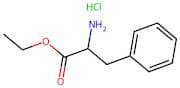
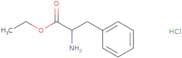
CAS 19881-53-9
:Phenylalanine, ethyl ester, hydrochloride (1:1)
Description:
Phenylalanine, ethyl ester, hydrochloride (1:1) is a chemical compound that serves as an ester derivative of the amino acid phenylalanine. It is characterized by its white crystalline appearance and is soluble in water due to the presence of the hydrochloride group, which enhances its solubility compared to the free base form. This compound is often utilized in biochemical research and pharmaceutical applications, particularly in the synthesis of peptides and as a potential precursor in the production of various pharmaceuticals. The ethyl ester form allows for improved absorption and bioavailability in biological systems. As a hydrochloride salt, it exhibits stability and ease of handling, making it suitable for laboratory use. Additionally, phenylalanine is an essential amino acid, meaning it must be obtained through diet, and its derivatives can play significant roles in metabolic processes. Safety data should be consulted for handling and exposure guidelines, as with any chemical substance.
Formula:C11H15NO2·ClH
InChI:InChI=1S/C11H15NO2.ClH/c1-2-14-11(13)10(12)8-9-6-4-3-5-7-9;/h3-7,10H,2,8,12H2,1H3;1H
InChI key:InChIKey=FPFQPLFYTKMCHN-UHFFFAOYSA-N
SMILES:C(C(C(OCC)=O)N)C1=CC=CC=C1.Cl
Synonyms:- (±)-Phenylalanine ethyl ester hydrochloride
- <span class="text-smallcaps">DL</span>-Phenylalanine, ethyl ester, hydrochloride
- Alanine, phenyl-, ethyl ester, hydrochloride, <span class="text-smallcaps">DL</span>-
- Ethyl 3-phenyl-DL-alaninate HCl
- Phenylalanine, ethyl ester, hydrochloride (1:1)
- ethyl L-phenylalaninate hydrochloride (1:1)
- Alanine, phenyl-, ethyl ester, hydrochloride, DL-
- DL-Phenylalanine, ethyl ester, hydrochloride
Sort by
Purity (%)
0
100
|
0
|
50
|
90
|
95
|
100
Found 3 products.
ethyl 3-phenyl-DL-alaninate hydrochloride
CAS:Ethyl 3-phenyl-DL-alaninate hydrochloride (3PA) is a potent and selective inhibitor of protein synthesis. It has been shown to inhibit the production of pro-inflammatory cytokines, such as tumor necrosis factor α (TNF-α), in vitro. 3PA is an amide that shows no significant toxicity or adverse effects in rats. This drug inhibits the enzyme activity of protein kinase C, which affects the function of several other enzymes, including cyclooxygenase and lipoxygenase. 3PA also has a skeletal effect by inhibiting the metabolism of amino acids and glycosides. The drug can be formulated as an ester hydrochloride salt for oral administration.
Formula:C11H16ClNO2Purity:Min. 95%Molecular weight:229.7 g/mol