CAS 19933-22-3
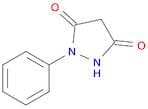
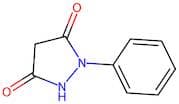
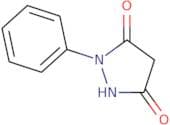
:1-phenylpyrazolidine-3,5-dione
Description:
1-Phenylpyrazolidine-3,5-dione, also known as phenylbutazone, is a chemical compound characterized by its pyrazolidine ring structure, which features two carbonyl groups at the 3 and 5 positions and a phenyl group at the 1 position. This compound is typically a white to off-white crystalline solid, exhibiting moderate solubility in organic solvents such as ethanol and dimethyl sulfoxide, but limited solubility in water. It is known for its anti-inflammatory and analgesic properties, making it useful in the treatment of conditions like arthritis and gout. The compound functions by inhibiting cyclooxygenase enzymes, thereby reducing the synthesis of prostaglandins involved in inflammation and pain. Its pharmacological profile includes potential side effects such as gastrointestinal issues and hematological disorders, necessitating careful monitoring during use. Additionally, 1-phenylpyrazolidine-3,5-dione has been studied for its potential role in various biochemical pathways, contributing to ongoing research in medicinal chemistry and pharmacology.
Formula:C9H8N2O2
InChI:InChI=1/C9H8N2O2/c12-8-6-9(13)11(10-8)7-4-2-1-3-5-7/h1-5H,6H2,(H,10,12)
SMILES:c1ccc(cc1)N1C(=O)CC(=N1)O
Synonyms:- 3,5-Pyrazolidinedione, 1-phenyl-
Sort by
Purity (%)
0
100
|
0
|
50
|
90
|
95
|
100
Found 4 products.
3,5-Pyrazolidinedione, 1-phenyl-
CAS:Formula:C9H8N2O2Purity:97%Color and Shape:SolidMolecular weight:176.17201-Phenylpyrazolidine-3,5-dione
CAS:1-Phenylpyrazolidine-3,5-dionePurity:97%Molecular weight:176.18g/mol1-Phenyl-pyrazolidine-3,5-dione
CAS:Formula:C9H8N2O2Purity:97%Color and Shape:SolidMolecular weight:176.1751-Phenyl-pyrazolidine-3,5-dione
CAS:1-Phenyl-pyrazolidine-3,5-dione is a synthetic compound that has been synthesized as an analog of the natural product pyrazolidine. It is a potential antibacterial agent that has shown in vitro activity against bacteria such as Escherichia coli and Pseudomonas aeruginosa. 1-Phenyl-pyrazolidine-3,5-dione inhibits protein synthesis by inhibiting tyrosine kinase, which is required for the production of proteins vital to cell division. It also exhibits antiinflammatory properties.
Formula:C9H8N2O2Purity:Min. 95%Molecular weight:176.18 g/mol