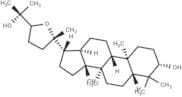
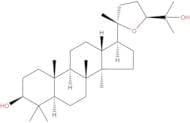
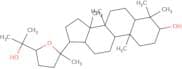
CAS 19942-04-2
:(3beta)-20,24-epoxydammarane-3,25-diol
Description:
(3beta)-20,24-epoxydammarane-3,25-diol is a triterpenoid compound characterized by its complex steroid-like structure, which includes a dammarane skeleton. This compound features an epoxide functional group at the 20 and 24 positions, contributing to its reactivity and potential biological activity. The presence of hydroxyl groups at the 3 and 25 positions enhances its solubility in polar solvents and may influence its interaction with biological systems. Triterpenoids like this one are often studied for their pharmacological properties, including anti-inflammatory, anticancer, and antimicrobial activities. The compound's stereochemistry, particularly the configuration at the 3beta position, plays a crucial role in determining its biological effects and interactions with cellular targets. Additionally, its natural occurrence in various plant species suggests potential applications in herbal medicine and natural product chemistry. Overall, (3beta)-20,24-epoxydammarane-3,25-diol represents a significant compound within the realm of natural products, warranting further investigation into its therapeutic potential and mechanisms of action.
Formula:C30H52O3
InChI:InChI=1/C30H52O3/c1-25(2)21-12-17-29(7)22(27(21,5)15-13-23(25)31)10-9-19-20(11-16-28(19,29)6)30(8)18-14-24(33-30)26(3,4)32/h19-24,31-32H,9-18H2,1-8H3/t19-,20+,21+,22-,23+,24?,27+,28-,29-,30+/m1/s1
Synonyms:- (3Β)-20,24-Epoxydammarane-3,25-Diol
- Dammarane-3,25-Diol, 20,24-Epoxy-, (3Β)-
Sort by
Purity (%)
0
100
|
0
|
50
|
90
|
95
|
100
Found 3 products.
3-Epicabraleadiol
CAS:3-Epicabraleadiol is a natural product of Camellia, Theaceae.Formula:C30H52O3Purity:98%Color and Shape:SolidMolecular weight:460.7433-Epicabraleadiol
CAS:Controlled Product3-Epicabraleadiol is a synthetic steroid compound that functions as a selective estrogen receptor modulator (SERM). It is derived from chemical synthesis processes that allow for the precise manipulation of steroid structures. This compound acts primarily by binding to estrogen receptors, leading to the modulation of estrogenic activity in various tissues. By doing so, it influences the transcription of estrogen-responsive genes, thereby altering cellular responses dependent on estrogen signaling.
Formula:C30H52O3Purity:Min. 95%Molecular weight:460.7 g/mol