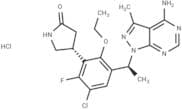
CAS 1995889-48-9
:Parsaclisib hydrochloride
Description:
Parsaclisib hydrochloride is a small molecule inhibitor primarily targeting the phosphoinositide 3-kinase (PI3K) pathway, specifically the delta isoform (PI3Kδ). This compound is notable for its role in the treatment of various hematological malignancies, including certain types of lymphomas and leukemias. As a hydrochloride salt, it enhances the solubility and stability of the active pharmaceutical ingredient. Parsaclisib exhibits a unique mechanism of action by selectively inhibiting PI3Kδ, which is crucial for the survival and proliferation of B cells. The compound is typically administered orally and has been evaluated in clinical trials for its efficacy and safety profile. Its pharmacokinetics suggest a favorable absorption and distribution, with a half-life that supports once-daily dosing. Common side effects may include immune-related reactions, given its impact on the immune system. Overall, Parsaclisib hydrochloride represents a targeted therapeutic approach in oncology, aiming to disrupt the signaling pathways that contribute to cancer cell growth and survival.
Formula:C20H23Cl2FN6O2
Synonyms:- Parsaclisib HCl
- INCB050465 Hydrochloride
- Parsaclisib hydrochloride,PI3K,inhibit,PI3Kδ,Phosphoinositide 3-kinase,B-cell,INCB050465,Inhibitor,Parsaclisib,malignancies,relapsed,refractory
- INCB-50465
- INCB050465 HCl
- INCB 50465
- Parsaclisib hydrochloride
- INCB50465 HCl
Sort by
Purity (%)
0
100
|
0
|
50
|
90
|
95
|
100
Found 2 products.
Parsaclisib hydrochloride
CAS:Parsaclisib hydrochloride (INCB050465 HCl) is a selectve PI3Kδ inhibitor with antitumor activity. Parsaclisib demonstrates potent activity.Formula:C20H23Cl2FN6O2Purity:98%Color and Shape:SolidMolecular weight:469.34Parsaclisib hydrochloride
CAS:Parsaclisib hydrochloride is a research tool that is used to study the activation of receptors. It has been shown to be a ligand for the Tumor Necrosis Factor Receptor (TNFR) and the receptor for Advanced Glycation End-Products (RAGE). Parsaclisib hydrochloride can also inhibit ion channels, such as calcium channels, potassium channels, and chloride channels. In addition, it has been shown to bind to antibodies and peptides. The binding of this drug affects these proteins' functions in cell biology and pharmacology.
Formula:C20H23Cl2FN6O2Purity:Min. 95%Molecular weight:469.3 g/molRef: 3D-VED88948
Discontinued product