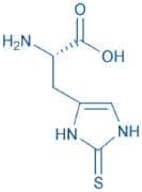
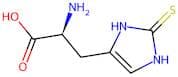
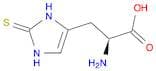
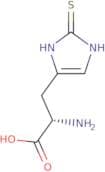
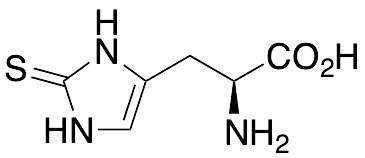
CAS 2002-22-4
:(αS)-α-Amino-2,3-dihydro-2-thioxo-1H-imidazole-4-propanoic acid
- (2S)-2-Azaniumyl-3-(2-sulfanylidene-1,3-dihydroimidazol-4-yl)propanoate
- (S)-2-Amino-3-(2-thioxo-2,3-dihydro-1H-imidazol-4-yl)propanoic acid
- (αS)-α-Amino-2,3-dihydro-2-thioxo-1H-imidazole-4-propanoic acid
- 1H-Imidazole-4-propanoic acid, α-amino-2,3-dihydro-2-thioxo-, (S)-
- 1H-Imidazole-4-propanoic acid, α-amino-2,3-dihydro-2-thioxo-, (αS)-
- 2-Mercapto-<span class="text-smallcaps">L</span>-histidine
- 2-Mercapto-L-histidine
- 2-Mercaptohistidine
- 3-(2-thioxo-2,3-dihydro-1H-imidazol-4-yl)-L-alanine
- <span class="text-smallcaps">L</span>-2-Mercaptohistidine
- <span class="text-smallcaps">L</span>-2-Thiolhistidine
- <span class="text-smallcaps">L</span>-2-Thioxohistidine
- <span class="text-smallcaps">L</span>-Thiohistidine
- Histidine, 2-mercapto-, <span class="text-smallcaps">L</span>-
- L-2-Mercaptohistidine
- See more synonyms
H-2-Mercapto-His-OH
CAS:Key intermediate in the synthesis of the naturally occurring amino acid L-(+)-ergothioneine and analogs.Formula:C6H9N3O2SPurity:≥ 98%Color and Shape:Yellowish PowderMolecular weight:187.22(S)-2-Amino-3-(2-thioxo-2,3-dihydro-1H-imidazol-4-yl)propanoic acid
CAS:(S)-2-Amino-3-(2-thioxo-2,3-dihydro-1H-imidazol-4-yl)propanoic acidFormula:C6H9N3O2SPurity:95%Molecular weight:187.221H-Imidazole-4-propanoic acid, α-amino-2,3-dihydro-2-thioxo-, (αS)-
CAS:Formula:C6H9N3O2SPurity:95%Color and Shape:SolidMolecular weight:187.21962-Mercapto-L-histidine
CAS:2-Mercapto-L-histidine is a dietary amino acid that has been shown to be an effective inhibitor of opportunistic fungal growth in vitro. It has been shown to have a second-order rate constant of 0.0037 s−1, which is the same as lysine and arginine. This compound also inhibits the growth of fungi by competing with tryptophan for binding sites on the enzyme histidine ammonia-lyase. 2-Mercapto-L-histidine can also react with nucleophiles such as divalent cations and form covalent bonds, which may lead to its antimicrobial activity against Gram-positive bacteria. 2-Mercapto-L-histidine is not active against Gram negative bacteria or yeast due to structural differences in their cell walls. 2-Mercapto-L-histidine has been shown to inhibit glucose metabolism and plasma glucose levels in vitro, but it does not affect insulin secretion orFormula:C6H9N3O2SPurity:Min. 95%Color and Shape:PowderMolecular weight:187.22 g/mol2-Mercapto-L-histidine
CAS:Controlled ProductApplications An intermediate in the formation of L-egothioneine, a natural amino acid ubiquitously present in cells and tissues of most plants and mammalian species. In humans, L-ergothioneine is found in red blood cells, liver, kidney, brain, seminal fluid, and cataract-free lenses at concentrations ranging from 100 uM to 2 mM. L-ergothioneine is exclusively biosynthesized in fungi and mycobacteria. Hence, humans assimilate it through dietary intake.L-ergothioneine has been proven to act as an antioxidant in vivo and to afford protection from g and UV radiation as well as from singlet oxygen in vivo. Recently, it has been shown that L-ergothioneine protects isolated perfused heart against the deleterious effect of post-ischemic reperfusion.The intermediate, 2-mercaptohistine has been used for the
References Makinen, K.K., et al.: Eur. J. Biochem., 123, 171 (1982), Howard, R.J., et al.: Biochem. Pharmacol., 35, 1589 (1986),Formula:C6H9N3O2SColor and Shape:NeatMolecular weight:187.22