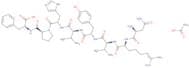
CAS 20071-00-5
:(asn1,val5)-angiotensin ii acetate
Description:
Angiotensin II acetate, with the CAS number 20071-00-5, is a peptide hormone that plays a crucial role in the regulation of blood pressure and fluid balance in the body. It is an octapeptide composed of amino acids and is derived from the precursor angiotensinogen. The specific structure of angiotensin II includes a sequence that allows it to bind to angiotensin receptors, leading to vasoconstriction and increased blood pressure. The acetate form indicates that the molecule is acetylated, which can influence its stability and solubility. Angiotensin II is known for its potent effects on the cardiovascular system, stimulating aldosterone secretion from the adrenal glands, promoting sodium reabsorption in the kidneys, and enhancing thirst. In research and clinical settings, angiotensin II is often studied for its implications in hypertension, heart failure, and other cardiovascular diseases. Its pharmacological applications include the treatment of certain types of shock and as a tool in various experimental protocols to understand cardiovascular physiology.
Formula:C51H74N14O13
InChI:InChI=1/C49H70N14O11.C2H4O2/c1-26(2)39(61-42(67)33(12-8-18-55-49(52)53)57-41(66)32(50)23-38(51)65)45(70)58-34(20-29-14-16-31(64)17-15-29)43(68)62-40(27(3)4)46(71)59-35(22-30-24-54-25-56-30)47(72)63-19-9-13-37(63)44(69)60-36(48(73)74)21-28-10-6-5-7-11-28;1-2(3)4/h5-7,10-11,14-17,24-27,32-37,39-40,64H,8-9,12-13,18-23,50H2,1-4H3,(H2,51,65)(H,54,56)(H,57,66)(H,58,70)(H,59,71)(H,60,69)(H,61,67)(H,62,68)(H,73,74)(H4,52,53,55);1H3,(H,3,4)/t32-,33-,34-,35-,36-,37-,39-,40-;/m0./s1
SMILES:CC(C)[C@@H](C(=N[C@@H](Cc1ccc(cc1)O)C(=N[C@@H](C(C)C)C(=N[C@@H](Cc1cnc[nH]1)C(=O)N1CCC[C@H]1C(=N[C@@H](Cc1ccccc1)C(=O)O)O)O)O)O)N=C([C@H](CCCNC(=N)N)N=C([C@H](CC(=N)O)N)O)O.CC(=O)O
Synonyms:- Angiotensin Acetate
Sort by
Purity (%)
0
100
|
0
|
50
|
90
|
95
|
100
Found 4 products.
Angiotensin acetate
CAS:Controlled ProductAngiotensin I is a peptide hormone that acts on the vasculature and other tissues to regulate blood pressure and fluid balance. Angiotensin acetate (AA) is a derivative of angiotensin I, which is used as a building block in organic synthesis. AA can be reacted with an amine or alcohol to form an amide or ester respectively. It is also used as a reagent in the synthesis of various drugs such as beta blockers and ACE inhibitors. Angiotensin acetate has been shown to have anti-fungal properties and can be used as a scaffold for drug design.Formula:C49H70N14O11•(C2H4O2)2Purity:Min. 95%Color and Shape:White PowderMolecular weight:1,151.27 g/mol


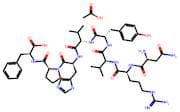

![[Asn1, Val5]-Angiotensin II](/_next/image/?url=https%3A%2Fstatic.cymitquimica.com%2Fproducts%2F7W%2Fthumb%2FGK1877.jpg&w=3840&q=75)