CAS 20133-19-1
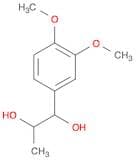
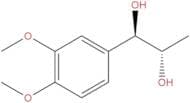
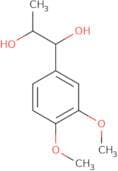
:1-(3,4-Dimethoxyphenyl)-1,2-propanediol
Description:
1-(3,4-Dimethoxyphenyl)-1,2-propanediol, identified by its CAS number 20133-19-1, is an organic compound characterized by its structure, which includes a propanediol backbone substituted with a 3,4-dimethoxyphenyl group. This compound typically appears as a colorless to pale yellow liquid or solid, depending on its purity and form. It is soluble in organic solvents, reflecting its hydrophobic characteristics due to the aromatic ring and methoxy groups. The presence of hydroxyl (-OH) groups in the propanediol structure imparts some degree of polarity, allowing for potential interactions with polar solvents. This compound may exhibit biological activity, making it of interest in pharmaceutical and chemical research. Its synthesis often involves the reaction of appropriate phenolic and alcohol precursors, and it may serve as an intermediate in the production of more complex organic molecules. Safety data should be consulted for handling and storage, as with any chemical substance, to ensure proper laboratory practices.
Formula:C11H16O4
InChI:InChI=1S/C11H16O4/c1-7(12)11(13)8-4-5-9(14-2)10(6-8)15-3/h4-7,11-13H,1-3H3
InChI key:InChIKey=HGABKKBQQGFTLR-UHFFFAOYSA-N
SMILES:C(C(C)O)(O)C1=CC(OC)=C(OC)C=C1
Synonyms:- Methyl isoeugenol glycol
- 1-(3,4-Dimethoxyphenyl)propane-1,2-diol
- 1-(3,4-Dimethoxyphenyl)-1,2-propanediol
- 1,2-Propanediol, 1-(3,4-dimethoxyphenyl)-
Sort by
Purity (%)
0
100
|
0
|
50
|
90
|
95
|
100
Found 4 products.
1-(3,4-Dimethoxyphenyl)propane-1,2-diol
CAS:β-Aflatrem is a natural product of Chloranthus, Chloranthaceae.Formula:C11H16O4Purity:98%Color and Shape:SolidMolecular weight:212.241-(3,4-Dimethoxyphenyl)propane-1,2-diol
CAS:Formula:C11H16O4Purity:95%~99%Color and Shape:PowderMolecular weight:212.2451-(3,4-Dimethoxyphenyl)propane-1,2-diol
CAS:1-(3,4-Dimethoxyphenyl)propane-1,2-diol (DMPD) is a sulfur-containing compound that is used as a disinfectant. It reacts with peracetic acid to form peracetic acid oxidation products. DMPD is produced by the reaction of 3,4-dimethoxybenzene and propane diol. DMPD can be used for wastewater treatment because it can remove organic matter from wastewater. The compounds are oxidized in the presence of oxygen in an environment with a pH of 2 to 5. DMPD's oxidizing power has been linked to its ability to form hydrogen sulfide and other sulfur compounds via pathways involving hydroxyl radicals or hydrogen peroxide. DMPD has shown promising results as an oxidant for coexisting anionic and cationic surfactants in research studies.
Formula:C11H16O4Purity:Min. 95%Molecular weight:212.24 g/molRef: 3D-VAA13319
1g944.00€1mgTo inquire5mgTo inquire10mgTo inquire25mgTo inquire50mgTo inquire100mg239.00€