CAS 201420-30-6
:4-Chloro-3-quinolinecarboxaldehyde
Description:
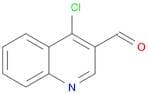
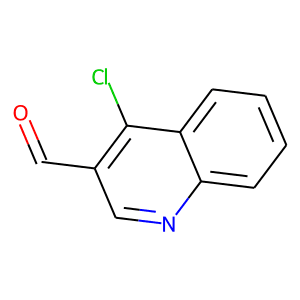
4-Chloro-3-quinolinecarboxaldehyde is an organic compound characterized by its quinoline structure, which consists of a fused benzene and pyridine ring. The presence of a chloro group at the 4-position and an aldehyde functional group at the 3-position contributes to its reactivity and potential applications in various chemical reactions. This compound typically appears as a yellow to brown solid and is soluble in organic solvents such as ethanol and dichloromethane. It is often utilized in synthetic organic chemistry, particularly in the development of pharmaceuticals and agrochemicals, due to its ability to participate in electrophilic aromatic substitution and other reactions. The compound's unique structure allows for the formation of derivatives that may exhibit biological activity, making it of interest in medicinal chemistry. Safety precautions should be observed when handling this substance, as it may pose health risks, including irritation to the skin and respiratory system. Proper storage in a cool, dry place away from light is recommended to maintain its stability.
Formula:C10H6ClNO
InChI:InChI=1/C10H6ClNO/c11-10-7(6-13)5-12-9-4-2-1-3-8(9)10/h1-6H
SMILES:c1ccc2c(c1)c(c(cn2)C=O)Cl
Synonyms:- 3-Quinolinecarboxaldehyde, 4-Chloro-
- 4-Chloroquinoline-3-carbaldehyde
Sort by
Purity (%)
0
100
|
0
|
50
|
90
|
95
|
100
Found 4 products.
3-Quinolinecarboxaldehyde, 4-chloro-
CAS:Formula:C10H6ClNOPurity:97%Color and Shape:SolidMolecular weight:191.61374-Chloroquinoline-3-carbaldehyde
CAS:4-Chloroquinoline-3-carbaldehydePurity:97%Molecular weight:191.61g/mol4-Chloroquinoline-3-carbaldehyde
CAS:4-Chloroquinoline-3-carbaldehyde is a monosubstituted aromatic compound. It has been studied in biological systems, where it has shown to have antioxidant and anti-inflammatory effects. 4-Chloroquinoline-3-carbaldehyde can be synthesized by the oxidation of 4-chloroquinoline with an oxidant such as hydrogen peroxide or potassium permanganate. The synthetic methods for this compound include the Wittig reaction and the naphthalene dihalogenation reaction, although these reactions are not typically used due to their hazardous nature. This chemical's fluorescence properties make it useful in fluorometric assays.Formula:C10H6ClNOPurity:Min. 95%Molecular weight:191.61 g/mol