CAS 2017-89-2
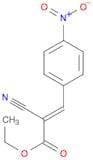
:2-Propenoic acid,2-cyano-3-(4-nitrophenyl)-, ethyl ester, (2E)-
Description:
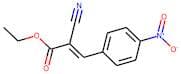
2-Propenoic acid, 2-cyano-3-(4-nitrophenyl)-, ethyl ester, commonly referred to as a cyanoacrylate derivative, is an organic compound characterized by its acrylate structure, which includes a propenoic acid backbone with a cyano group and a nitrophenyl substituent. This compound typically appears as a colorless to pale yellow liquid and is known for its reactivity, particularly in polymerization processes. The presence of the cyano group enhances its electron-withdrawing properties, which can influence its reactivity and stability. The nitrophenyl group contributes to the compound's potential applications in materials science and organic synthesis, often serving as a chromophore or a site for further chemical modification. Additionally, the ethyl ester functionality provides solubility in organic solvents, making it useful in various chemical reactions. Safety considerations should be taken into account, as compounds of this nature can be hazardous and require proper handling and storage protocols. Overall, this compound is of interest in both academic research and industrial applications due to its unique structural features and reactivity.
Formula:C12H10N2O4
Synonyms:- 2-Propenoicacid, 2-cyano-3-(4-nitrophenyl)-, ethyl ester, (E)-
- Cinnamic acid, a-cyano-p-nitro-, ethyl ester,(E)- (8CI)
Sort by
Purity (%)
0
100
|
0
|
50
|
90
|
95
|
100
Found 3 products.
2-Propenoic acid, 2-cyano-3-(4-nitrophenyl)-, ethyl ester, (2E)-
CAS:Formula:C12H10N2O4Molecular weight:246.2188Ethyl 2-cyano-3-(4-nitrophenyl)acrylate
CAS:Ethyl 2-cyano-3-(4-nitrophenyl)acrylatePurity:≥95%Molecular weight:246.22g/molethyl 2-cyano-3-(4-nitrophenyl)prop-2-enoate
CAS:Ethyl 2-cyano-3-(4-nitrophenyl)prop-2-enoate is a functionalized molecule that contains a dipole. It has high selectivity for 1,3-dipolar cycloadditions because the electron density of the methylene group is greater than that of the aldehyde group. The mechanistic theory for this reaction is that the electron density on the methylene group in ethyl 2-cyano-3-(4-nitrophenyl)prop-2-enoate will cause it to become more reactive than the aldehyde group. The dipoles in this molecule are oriented such that they can react with each other to form an intermediate and then an adduct. This isomerization occurs through either dipolarophilic or electrocyclic mechanisms.Purity:Min. 95%