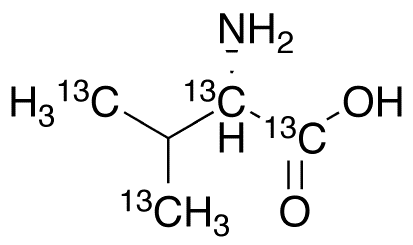
CAS 202407-30-5
:L-VALINE-13C5, 15N
Description:
L-Valine-13C5, 15N is a stable isotope-labeled form of the amino acid valine, which is one of the essential branched-chain amino acids (BCAAs) important for protein synthesis and metabolic processes in the body. The designation "13C5" indicates that five of the carbon atoms in the molecule are replaced with the stable isotope carbon-13, while "15N" signifies that one of the nitrogen atoms is replaced with the stable isotope nitrogen-15. These isotopic substitutions are often used in research and analytical applications, such as metabolic studies, tracer experiments, and NMR spectroscopy, to track the incorporation and metabolism of amino acids in biological systems. L-Valine itself is a hydrophobic amino acid, contributing to protein structure and function, and plays a role in muscle metabolism and energy production. The compound is typically used in biochemical research, particularly in studies involving protein dynamics and metabolic pathways.
Formula:C5H11NO2
Synonyms:- NSC 76038-13C5,15N
- Valine Impurity 43
- (2S)-2-AMino-3-Methylbutanoic Acid-13C5,15N
- L-VALINE (U-13C5, 15N)
- 13C and 15N Labeled L-valine
- [13C5,15N]-L-Valine
- H-Val-OH(13C5,15N)
- L-α-AMino-β-Methylbutyric Acid-13C5,15N
- (S)-α-AMino-β-Methylbutyric Acid-13C5,15N
- L-Valine-ul-13C,15N
- (S)-Valine-13C5,15N
- L-2-Amino-3-methylbutanoic acid-13C5,15N
- L-Valine-[13C5,14N
- L-VALINE-13C5, 15N
- L-(+)-α-AMinoisovaleric Acid-13C5,15N
- L-Valine-13C5,1?N
- (+)-2-AMino-3-Methylbutyric Acid-13C5,15N
- (S)-α-Aminoisovaleric acid-13C5,15N
- See more synonyms
Sort by
Purity (%)
0
100
|
0
|
50
|
90
|
95
|
100
Found 4 products.
L-Valine-13C5,15N
CAS:Controlled ProductApplications Labelled analogue of L-Vailne. L-Valine is an essential amino acid and one of 20 proteinogenic amino acids. L-Valine cannot be manufactured by the body and must be acquired through diet or supplementation. L-valine is found in grains, dairy products, mushrooms, meats, peanuts and soy proteins. L-Valine has been used in studies to attenuate arrhythmias and induce hypotensive effects.
References Choi, C.W. et al.: Anim. Feed Sci. Technol., 102, 15 (2002); Kolarski, D. et al.: Krmiva, 30, 155 (1988); Oba, M. et al.: J. Dairy Sci., 93, 2044 (2010); Mitrega, K. et al.: Pharmacol. Res., 64, 218 (2011);Formula:C5H1115NO2Color and Shape:NeatMolecular weight:123.1L-Valine-13C5-15N
CAS:L-Valine-13C5-15N is the 13C and 15N labeled compound of L-Valine. L-Valine has a CAS number of 72-18-4. A branched-chain essential amino acid that has stimulant activity. It promotes muscle growth and tissue repair. It is a precursor in the penicillin biosynthetic pathway.Formula:CC4D0H11NO2Color and Shape:SolidMolecular weight:123.10