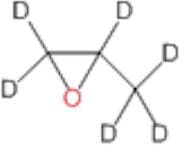
CAS 202468-69-7
:propylene-D6 oxide
Description:
Propylene-D6 oxide, with the CAS number 202468-69-7, is a deuterated form of propylene oxide, a three-membered cyclic ether. This compound is characterized by its unique structure, which includes a strained epoxide ring that contributes to its reactivity. The presence of deuterium atoms in place of hydrogen enhances its stability and alters its physical properties, making it useful in various applications, particularly in research and analytical chemistry. Propylene-D6 oxide is typically a colorless liquid with a relatively low boiling point and is soluble in organic solvents. Its reactivity allows it to participate in various chemical reactions, including ring-opening reactions and nucleophilic attacks, making it valuable in synthesizing other chemical compounds. Additionally, the use of deuterated compounds like propylene-D6 oxide is significant in NMR spectroscopy, where the deuterium label can provide insights into molecular dynamics and interactions. Overall, propylene-D6 oxide serves as an important tool in both industrial applications and scientific research.
Sort by
Purity (%)
0
100
|
0
|
50
|
90
|
95
|
100
Found 3 products.
(+/-)-1,2-Propylene-d6 Oxide(stabilized with hydroquinone)
CAS:Purity:98 atom % DColor and Shape:Colourless LiquidMolecular weight:64.12(+/-)-1,2-Propylene-d6 Oxide (Stabilized with hydroquinone)
CAS:Controlled ProductApplications Isotope labelled (±)-Propylene Oxide (P835241), which is a carcinogenic substance to rats and potentially humans (1). (±)-Propylene oxide also has the ability to self-polymerize at room temperature in the presence of powdered potassium hydroxide (2). (±)-Propylene oxide is used in industry for fumigation in the food industry, inducing the formation of persistent toxic chlorohydrins. Drinking water contaminant candidate list 3 (CCL 3) compound as per United States Environmental Protection Agency (EPA), environmental, and food contaminants.
E3
References 1. Narang, S. et al.: Ind. Eng. Chem. Res. 2013 Feb:52(11);3967-39732. Timofeeva, M. et al.: Microporous Mesoporous Mater. 2013 Jan:165(1);84-91Formula:C32H6OColor and Shape:NeatMolecular weight:64.12