CAS 2025-95-8
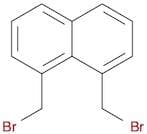
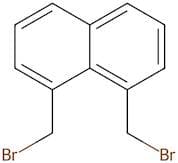
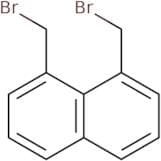
:1,8-bis(bromomethyl)naphthalene
Description:
1,8-Bis(bromomethyl)naphthalene is an organic compound characterized by its naphthalene backbone with two bromomethyl groups attached at the 1 and 8 positions. This compound is typically a white to light yellow solid at room temperature and is known for its reactivity due to the presence of bromine atoms, which can participate in various chemical reactions, including nucleophilic substitutions. It is often used as an intermediate in organic synthesis, particularly in the preparation of more complex molecules. The presence of the bromomethyl groups enhances its utility in cross-coupling reactions and as a building block for polymerization processes. Additionally, 1,8-bis(bromomethyl)naphthalene exhibits moderate solubility in organic solvents, making it suitable for various laboratory applications. Safety precautions should be taken when handling this compound, as brominated compounds can be hazardous and may pose environmental risks. Proper storage and disposal methods are essential to mitigate any potential hazards associated with its use.
Formula:C12H10Br2
InChI:InChI=1/C12H10Br2/c13-7-10-5-1-3-9-4-2-6-11(8-14)12(9)10/h1-6H,7-8H2
SMILES:c1cc2cccc(CBr)c2c(c1)CBr
Sort by
Purity (%)
0
100
|
0
|
50
|
90
|
95
|
100
Found 4 products.
NAPHTHALENE, 1,8-BIS(BROMOMETHYL)-
CAS:Formula:C12H10Br2Purity:98%Color and Shape:SolidMolecular weight:314.01581,8-Bis(bromomethyl)naphthalene
CAS:1,8-Bis(bromomethyl)naphthalene is a naphthalene compound that has been shown to be a monoradical. It is synthesized by the replacement of two hydrogen atoms with bromine in the molecule. This reaction produces an alkylating agent and a molecule with a β-unsaturated aldehyde group. The compound has been studied using X-ray diffraction, where it has been found to have reactivity similar to other molecules with carbonyl groups. 1,8-Bis(bromomethyl)naphthalene has also been synthesized and studied by functional theory calculations. These calculations show that the bond lengths for this molecule are closer to those of benzene than those of naphthalene, which may account for its unusual reactivity.
Formula:C12H10Br2Purity:Min. 95%Color and Shape:PowderMolecular weight:314.02 g/mol