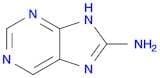
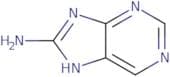
CAS 20296-09-7
:8-Aminopurine
Description:
8-Aminopurine is a purine derivative characterized by the presence of an amino group at the 8-position of the purine ring. Its molecular formula is C5H6N4, and it has a molecular weight of approximately 138.13 g/mol. This compound is typically a white to light yellow crystalline solid that is soluble in water and polar organic solvents. 8-Aminopurine is known for its role as a nucleobase analog, which can interfere with nucleic acid synthesis and function, making it of interest in biochemical research and potential therapeutic applications. It can act as a mutagen and has been studied for its effects on DNA and RNA processes. Additionally, 8-Aminopurine can be used in plant biology to influence growth and development, particularly in studies related to plant hormones and signaling pathways. Its reactivity and interactions with other biomolecules make it a valuable compound in both molecular biology and pharmacology.
Formula:C5H5N5
InChI:InChI=1/C5H5N5/c6-5-9-3-1-7-2-8-4(3)10-5/h1-2H,(H3,6,7,8,9,10)
SMILES:c1c2c(ncn1)[nH]c(=N)[nH]2
Synonyms:- 8-Amino-7H-purine
- 9H-purin-8-amine
Sort by
Purity (%)
0
100
|
0
|
50
|
90
|
95
|
100
Found 2 products.
8-Aminopurine
CAS:8-Aminopurine is an aminopurine that is used as a research tool in magnetic resonance spectroscopy. The proton magnetic resonance spectrum of 8-aminopurine shows two characteristic peaks at 3.0 and 4.2 ppm, which are assigned to the aminopurine tautomers (3-HPA, 4-HPA). The kinetic stability of 8-aminopurine in water is pH dependent and has been shown to be strongly dependent on the presence of aldehyde oxidase (AO) activity. AO activity can be inhibited by the addition of dimethylformamide or other non-specific inhibitors such as 2,6-dichloroisonicotinic acid.
Formula:C5H5N5Purity:Min. 95%Color and Shape:White PowderMolecular weight:135.13 g/mol