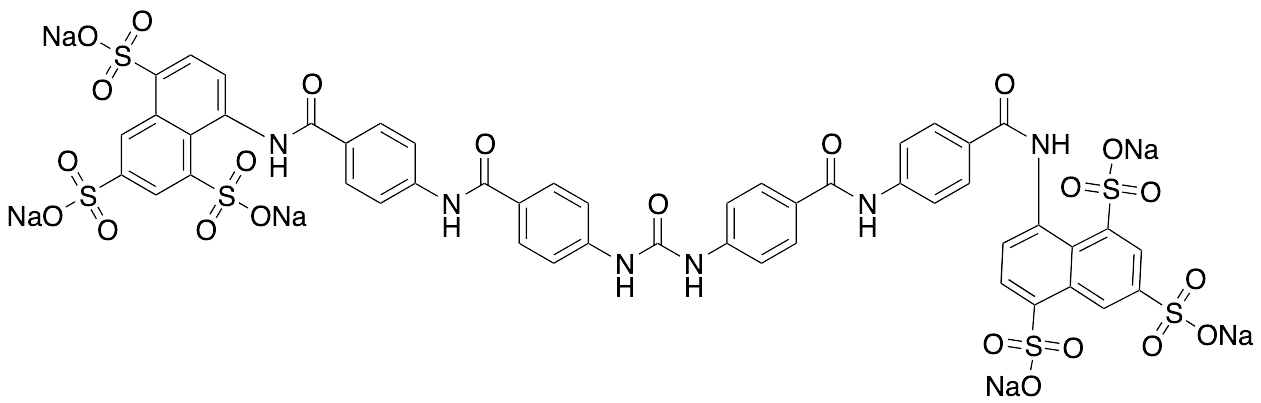
CAS 202983-32-2
:1,3,5-Naphthalenetrisulfonicacid,8,8'-[carbonylbis(imino-4,1-phenylenecarbonylimino-4,1-phenylenecarbonylimino)]bis-,sodium salt (1:6)
- 1,3,5-Naphthalenetrisulfonicacid,8,8'-[carbonylbis(imino-4,1-phenylenecarbonylimino-4,1-phenylenecarbonylimino)]bis-,hexasodium salt (9CI)
- Nf 279
NF279
CAS:P2X1 antagonistFormula:C49H36N6Na6O23S6Purity:98%Color and Shape:SolidMolecular weight:1407.17NF 279
CAS:Applications NF 279 is a potent and selective P2X1 antagonist.
References Kassack, M., et al.: Eur. J. Med. Chem., 39, 345 (2004); Damer, S., et al.: Eur. J. Pharm., 350, R5 (1998); Rettinger, J., et al.: Neuropharm., 39, 2044 (2000)Formula:C49H30N6O23S6·6NaColor and Shape:NeatMolecular weight:1401.12NF279
CAS:NF279 is a low-potency, orally active, small molecule that was designed to act as a potent and selective antagonist of the P2Y receptor. It binds to the p2y receptor and blocks its activity. NF279 has demonstrated efficacy against autoimmune diseases in animal models, and it is being studied as a potential treatment for HIV infection. In addition, NF279 has been shown to reduce the release of glutamate in primary cells, which may contribute to its ability to treat anxiety disorders. NF279 also blocks detrusor muscle contractions and reduces intracellular Ca2+ levels in bladder cells isolated from rats with overactive bladders.
Formula:C49H30N6O23S6·6NaPurity:Min. 95%Molecular weight:1,401.12 g/mol