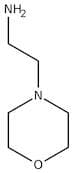
CAS 2038-03-1
:N-(2-Aminoethyl)morpholine
- 1-Amino-2-morpholinoethane
- 2-(4-Morpholino)ethylamine
- 2-(4-Morpholinyl)ethanamine
- 2-(4-Morpholinyl)ethylamine
- 2-(Morpholin-4-Yl)Ethanamine
- 2-(Morpholin-4-yl)ethan-1-amine
- 2-(Morpholin-4-yl)ethaneamine
- 2-Morfolinoetilamina
- 2-Morpholino-1-ethanamine
- 2-Morpholinoethanamine
- 2-Morpholinoethylamin
- 2-Morpholinoethylamine
- 4-(2-Aminoethyl)-Morpholin
- 4-(2-Aminoethyl)Morpholine
- 4-(2-Ammonioethyl)Morpholin-4-Ium
- 4-Aminoethylmorpholine
- 4-Morpholine Ethanamine
- 4-Morpholineethanamine
- Morpholine, 4-(2-aminoethyl)-
- Morpholine, N-(2-Aminoethyl)-
- N-(2-Aminoaethyl)-Morpholin
- N-(β-Aminoethyl)morpholine
- N-Aminoethyl Morpholine
- Rarechem Al Bw 0412
- [2-(Morpholin-4-yl)ethyl]amine
- beta-Aminoaethyl-morpholin
- β-Morpholinoethylamine
- N-(2-Aminoethyl)morpholine
- N-(2-aminoethyl) morpholine
- beta-Morpholinoethylamine
- 2-MORPHOLIN-4-YL-ETHYLAMINE
- N-(beta-Aminoethyl)morpholine
- N-2-Aminoethylmorfolin
- Morpholinoethylamine
- LABOTEST-BB LT02100621
- See more synonyms
4-(2-Aminoethyl)morpholine, 98+%
CAS:4-(2-Aminoethyl)morpholine is used as a ligand and reacts with nickel(II) nitrite to form trans-bis[4-(2-aminoethyl)morpholine]dinitronickel(II). This Thermo Scientific Chemicals brand product was originally part of the Alfa Aesar product portfolio. Some documentation and label information may refFormula:C6H14N2OPurity:98+%Color and Shape:Liquid as melt, Clear colorless to yellowMolecular weight:130.194-(2-Aminoethyl)morpholine
CAS:4-(2-Aminoethyl)morpholineFormula:C6H14N2OPurity:≥95%Color and Shape: clear. almost colourless low melting solid or liquidMolecular weight:130.18816g/mol4-(2-Aminoethyl)morpholine
CAS:Formula:C6H14N2OPurity:>98.0%(GC)(T)Color and Shape:White or Colorless to Light yellow powder to lump to clear liquidMolecular weight:130.19N-(2-Aminoethyl)morpholine
CAS:Formula:C6H14N2OPurity:98%Color and Shape:Solidified mass or fragmentsMolecular weight:130.1914-(2-Aminoethyl)morpholine
CAS:Controlled ProductStability Air Sensitive
Applications 4-(2-Aminoethyl)morpholine is used as a reagent in the synthesis of novel quinoxaline-5-carboxamide derivatives which have antibacterial activity. Also used as a reagent in the synthesis of pyrazol-4-ylpyrimidine derivatives as potential ROS1 kinase inhibitors.
Not a dangerous good if item is equal to or less than 1g/ml and there is less than 100g/ml in the package
References Srinivas, K., et al.: J. Appl. Chem., 3, 1432 (2014); Abdelazem, A.Z., et al.: Eur. J. Med. Chem., 90, 195 (2015)Formula:C6H14N2OColor and Shape:NeatMolecular weight:130.194-(2-Aminoethyl)morpholine
CAS:4-(2-Aminoethyl)morpholine (4AME) is a chemical compound that is used as an antimicrobial agent. The apoptotic effect of 4AME has been shown in cancer cells, which are resistant to the induction of apoptosis by other chemotherapeutic agents. 4AME induces apoptosis by interfering with the mitochondrial membrane potential and inhibiting the activity of respiratory enzymes, leading to cell death. 4AME also has a cytotoxic effect on mitochondria and induces oxidative stress in cancer cells due to its ability to form an intramolecular hydrogen bond with amines in proteins. This hydrogen bond may transfer reactions between molecules or cause structural changes in protein structures, leading to cell death.
Formula:C6H14N2OPurity:Min. 95%Color and Shape:Colorless Clear LiquidMolecular weight:130.19 g/mol