CAS 2040-26-8
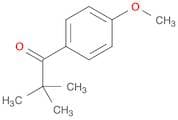
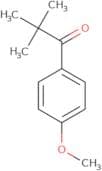
:1-(4-methoxyphenyl)-2,2-dimethylpropan-1-one
Description:
1-(4-Methoxyphenyl)-2,2-dimethylpropan-1-one, also known as p-Methoxyphenyl-2,2-dimethylpropan-1-one, is an organic compound characterized by its ketone functional group. It features a methoxy group (-OCH3) attached to a phenyl ring, which contributes to its aromatic properties. The presence of the dimethyl group indicates that it has two methyl groups attached to the carbon adjacent to the carbonyl group, enhancing its steric bulk. This compound is typically a colorless to pale yellow liquid or solid, depending on its purity and temperature. It is known for its applications in organic synthesis and as a potential intermediate in the production of pharmaceuticals and other organic compounds. The compound's molecular structure suggests it may exhibit moderate to low solubility in water, while being more soluble in organic solvents. Additionally, it may possess certain biological activities, making it of interest in medicinal chemistry. Safety data should be consulted for handling and storage, as with any chemical substance.
Formula:C12H16O2
InChI:InChI=1/C12H16O2/c1-12(2,3)11(13)9-5-7-10(14-4)8-6-9/h5-8H,1-4H3
SMILES:CC(C)(C)C(=O)c1ccc(cc1)OC
Synonyms:- 1-Propanone, 1- (4-methoxyphenyl)-2,2-dimethyl-
- 4-Methoxyphenyl tert-butyl ketone
- tert-Butyl 4-methoxyphenyl ketone
Sort by
Purity (%)
0
100
|
0
|
50
|
90
|
95
|
100
Found 3 products.
1-Propanone, 1-(4-methoxyphenyl)-2,2-dimethyl-
CAS:Formula:C12H16O2Purity:97%Molecular weight:192.25421-(4-Methoxyphenyl)-2,2-dimethylpropan-1-one
CAS:1-(4-Methoxyphenyl)-2,2-dimethylpropan-1-one is a bioorganic compound with the formula CHClO. It is an aromatic ketone that is used in organic synthesis. The compound is prepared by acylation of 4-methoxybenzaldehyde with chloroacetyl chloride in the presence of aluminum chloride as a catalyst. The reaction is catalyzed by light and proceeds quantitatively at room temperature, affording 1-(4-methoxyphenyl)-2,2-dimethylpropan-1-one in nearly quantitative yield. Friedel–Crafts acylation can be used to synthesize derivatives of this compound, such as benzoyl derivatives. The reaction takes place at room temperature under mild conditions and typically gives products in high yields. The reaction time for Friedel–Crafts acylation depends on the reactivity of the substrate but typically ranges from one to several hours,Formula:C12H16O2Purity:Min. 95%Molecular weight:192.25 g/mol