CAS 204067-01-6
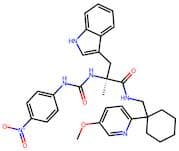
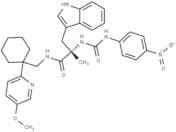
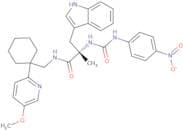
:3-(1H-Indol-3-yl)-N-[1-(5-methoxy-2-pyridinyl)cyclohexylmethyl]-2(S)-methyl-2-[3-(4-nitrophenyl)ureido]propionamide
Description:
The chemical substance known as 3-(1H-Indol-3-yl)-N-[1-(5-methoxy-2-pyridinyl)cyclohexylmethyl]-2(S)-methyl-2-[3-(4-nitrophenyl)ureido]propionamide, with the CAS number 204067-01-6, is a complex organic compound characterized by its diverse functional groups and structural features. It contains an indole moiety, which is known for its aromatic properties and biological significance, particularly in pharmaceuticals. The presence of a pyridine ring contributes to its potential interactions in biological systems, while the cyclohexylmethyl group may enhance lipophilicity, influencing its pharmacokinetic properties. The urea functional group, along with the nitrophenyl substituent, suggests potential for hydrogen bonding and reactivity, which could be relevant in medicinal chemistry. This compound may exhibit specific biological activities, making it of interest in drug development, particularly in the context of targeting certain receptors or pathways. Its synthesis and characterization would involve standard organic chemistry techniques, and its stability, solubility, and reactivity would be critical for its application in research or therapeutic contexts.
Formula:C32H36N6O5
Synonyms:- Pd-176252
Sort by
Purity (%)
0
100
|
0
|
50
|
90
|
95
|
100
Found 3 products.
PD176252
CAS:PD176252 is a BB1 and BB2 antagonist, GRPR inhibitor, and FPR1/FPR2 agonist that inhibits the growth and proliferation of a wide range of cancer cells.Formula:C32H36N6O5Purity:99.00%Color and Shape:SolidMolecular weight:584.67PD 176252
CAS:PD 176252 is a cytosolic calcium ionophore that has been shown to enhance the cytotoxicity of cisplatin in cancer cells. It binds to cyclic adenosine monophosphate (cAMP) and increases intracellular calcium concentrations by opening the channels of R-type voltage dependent calcium channels. PD 176252 also inhibits epidermal growth factor receptor tyrosine kinase activity, which may contribute its anti-cancer effects. The molecular modeling study showed that PD 176252 binds to the peptide binding site on metalloproteases by hydrogen bonding with the backbone amide group of Asp residues, which are often found in this region. This drug does not inhibit proteolysis, but blocks the catalytic domain of metalloproteases from binding to substrates.Formula:C32H36N6O5Purity:Min. 95%Molecular weight:584.67 g/mol