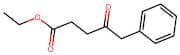
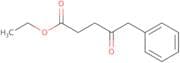
CAS 20416-11-9
:Ethyl γ-oxobenzenepentanoate
Description:
Ethyl γ-oxobenzenepentanoate, with the CAS number 20416-11-9, is an organic compound that belongs to the class of esters. It is characterized by the presence of an ethyl group, a pentanoate chain, and a ketone functional group (the γ-oxo group) attached to a benzene ring. This compound typically appears as a colorless to pale yellow liquid with a pleasant odor. Its molecular structure suggests it has moderate polarity due to the ester and ketone functionalities, which can influence its solubility in various solvents. Ethyl γ-oxobenzenepentanoate may exhibit reactivity typical of esters, such as hydrolysis in the presence of water or alcohols, and can participate in various organic reactions, including condensation and acylation. The compound's properties, such as boiling point, melting point, and density, can vary based on environmental conditions and purity. It is important to handle this substance with care, following appropriate safety protocols, as it may pose health risks if ingested or inhaled.
Formula:C13H16O3
InChI:InChI=1S/C13H16O3/c1-2-16-13(15)9-8-12(14)10-11-6-4-3-5-7-11/h3-7H,2,8-10H2,1H3
InChI key:InChIKey=ORGPSJHOOQCAES-UHFFFAOYSA-N
SMILES:C(C(CCC(OCC)=O)=O)C1=CC=CC=C1
Synonyms:- Benzenepentanoic acid, γ-oxo-, ethyl ester
- Levulinic acid, 5-phenyl-, ethyl ester
- Ethyl γ-oxobenzenepentanoate
- ethyl 4-oxo-5-phenylpentanoate
- 5-Phenyllevulinic acid ethyl ester
- 4-Oxo-5-phenylpentanoic acid ethyl ester
Sort by
Purity (%)
0
100
|
0
|
50
|
90
|
95
|
100
Found 2 products.
Ethyl 4-oxo-5-phenylpentanoate
CAS:Ethyl 4-oxo-5-phenylpentanoatePurity:95%Molecular weight:220.27g/molEthyl 4-oxo-5-phenylpentanoate
CAS:Ethyl 4-oxo-5-phenylpentanoate (ETP) is a synthetic chemical that can be used as a test compound for cancer research. ETP has been shown to inhibit the growth of human breast cancer cells in vitro and in vivo. It has also been shown to have an inhibitory effect on the growth of liver cancer cells. ETP inhibits the production of endogenous retinoids, which are naturally occurring compounds derived from vitamin A, by binding to lysine residues on histones. This prevents the transcription and replication of DNA, thereby preventing cell division. The terminal half-life of this compound is approximately 1 hour in humans.Formula:C13H16O3Purity:Min. 95%Molecular weight:220.26 g/mol