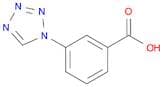
CAS 204196-80-5
:Benzoic acid, 3-(1H-tetrazol-1-yl)-
Description:
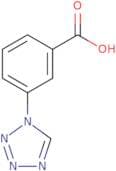
Benzoic acid, 3-(1H-tetrazol-1-yl)-, is an organic compound characterized by the presence of both a benzoic acid moiety and a tetrazole ring. The molecular structure features a benzene ring attached to a carboxylic acid group (-COOH) and a tetrazole group, which is a five-membered ring containing four nitrogen atoms and one carbon atom. This compound exhibits properties typical of both benzoic acids and heterocyclic compounds, including potential acidity due to the carboxylic acid functional group and unique reactivity associated with the tetrazole ring. It may display solubility in polar solvents and can participate in various chemical reactions, such as esterification or amidation. The presence of the tetrazole group may also impart biological activity, making it of interest in pharmaceutical research. Overall, benzoic acid, 3-(1H-tetrazol-1-yl)- is a versatile compound with applications in organic synthesis and medicinal chemistry.
Formula:C8H6N4O2
Sort by
Purity (%)
0
100
|
0
|
50
|
90
|
95
|
100
Found 3 products.
Benzoic acid, 3-(1H-tetrazol-1-yl)-
CAS:Formula:C8H6N4O2Purity:98%Color and Shape:SolidMolecular weight:190.15883-Tetrazol-1-yl-benzoic acid
CAS:Formula:C8H6N4O2Purity:98%Color and Shape:Solid, PowderMolecular weight:190.1623-(1H-Tetraazol-1-yl)benzoic acid
CAS:3-(1H-Tetraazol-1-yl)benzoic acid is an ion-selective electrode that has been used to measure the concentrations of Na+ and K+ ions in aqueous solutions. It is also used as a reference electrode in potentiometric titrations. The sensitivity of this electrode is linear over a wide range, and it responds rapidly to changes in solution composition. This electrode can be used with metal cations, but not with membrane ionophores such as gramicidin S or valinomycin.
Formula:C8H6N4O2Purity:Min. 95%Molecular weight:190.16 g/mol