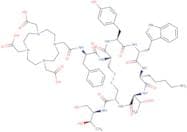
CAS 204318-14-9
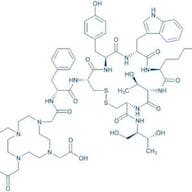
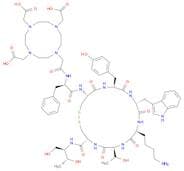
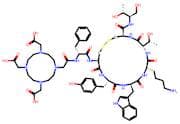
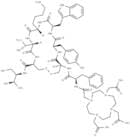
:2,2',2''-[10-(2-{[(2R)-1-{[(4R,7S,10S,13R,16S,19R)-10-(4-aminobutyl)-4-{[(2R,3R)-1,3-dihydroxybutan-2-yl]carbamoyl}-16-(4-hydroxybenzyl)-7-[(1R)-1-hydroxyethyl]-13-(1H-indol-3-ylmethyl)-6,9,12,15,18-pentaoxo-1,2-dithia-5,8,11,14,17-pentaazacycloicosan-19-
Description:
The chemical substance with the name "2,2',2''-[10-(2-{[(2R)-1-{[(4R,7S,10S,13R,16S,19R)-10-(4-aminobutyl)-4-{[(2R,3R)-1,3-dihydroxybutan-2-yl]carbamoyl}-16-(4-hydroxybenzyl)-7-[(1R)-1-hydroxyethyl]-13-(1H-indol-3-ylmethyl)-6,9,12,15,18-pentaoxo-1,2-dithia-5,8,11,14,17-pentaazacycloicosan-19-" and CAS number "204318-14-9" is a complex organic molecule characterized by its intricate structure, which includes multiple functional groups and stereocenters. This compound likely exhibits significant biological activity due to its structural features, which may include amine, hydroxyl, and carbonyl groups, contributing to its potential interactions with biological targets. The presence of a pentaazacycloicosane core suggests a unique cyclic framework that may influence its pharmacokinetics and pharmacodynamics. Additionally, the stereochemistry indicated by the (R) and (S) designations implies that the molecule may have specific spatial arrangements that are crucial for its biological function. Overall, this substance represents a sophisticated example of synthetic organic chemistry with potential applications in medicinal chemistry or drug development.
Formula:C65H92N14O18S2
InChI:InChI=1/C65H92N14O18S2/c1-39(81)51(36-80)72-64(96)53-38-99-98-37-52(73-60(92)48(28-41-10-4-3-5-11-41)68-54(84)32-76-20-22-77(33-55(85)86)24-26-79(35-57(89)90)27-25-78(23-21-76)34-56(87)88)63(95)70-49(29-42-15-17-44(83)18-16-42)61(93)71-50(30-43-31-67-46-13-7-6-12-45(43)46)62(94)69-47(14-8-9-19-66)59(91)75-58(40(2)82)65(97)74-53/h3-7,10-13,15-18,31,39-40,47-53,58,67,80-83H,8-9,14,19-30,32-38,66H2,1-2H3,(H,68,84)(H,69,94)(H,70,95)(H,71,93)(H,72,96)(H,73,92)(H,74,97)(H,75,91)(H,85,86)(H,87,88)(H,89,90)/t39-,40-,47+,48-,49+,50-,51-,52+,53+,58+/m1/s1
Sort by
Purity (%)
0
100
|
0
|
50
|
90
|
95
|
100
Found 5 products.
DOTA-(Tyr³)-Octreotide
CAS:Somatostatin analog for tumor scintigraphy and radionuclide therapy.Formula:C65H92N14O18S2Purity:98.4%Color and Shape:WhiteMolecular weight:1421.662,2',2''-(10-(2-(((R)-1-(((4R,7S,10S,13R,16S,19R)-13-((1H-Indol-3-yl)methyl)-10-(4-aminobutyl)-4-(((2R,3R)-1,3-dihydroxybutan-2-yl)carbamoyl)-16-(4-hydroxybenzyl)-7-((R)-1-hydroxyethyl)-6,9,12,15,18-pentaoxo-1,2-dithia-5,8,11,14,17-pentaazacycloicosan-19-yl)amino)-1-oxo-3-phenylpropan-2-yl)amino)-2-oxoethyl)-1,4,7,10-tetraazacyclododecane-1,4,7-triyl)triacetic acid
CAS:Formula:C65H92N14O18S2Purity:98%Color and Shape:SolidMolecular weight:1421.6390Edotreotide
CAS:Edotreotide (SMT-487) is an Indicator and Reagent. It also is used in the Diagnosis and Staging of Tumors Expressing Somatostatin Receptors.Formula:C65H92N14O18S2Purity:96.95%Color and Shape:SolidMolecular weight:1421.64Edotreotide trifluoroacetate
CAS:Edotreotide trifluoroacetate is a diagnostic agent that is used to diagnose hepatic steatosis. It is a synthetic analog of somatostatin, which can be synthesized by the reaction of trifluoroacetic acid and hydroxyl compounds. Edotreotide trifluoroacetate is radiolabeled with technetium-99m and administered intravenously. The drug binds to receptors on the surface of proximal tubule cells in the liver, causing an uptake of this radionuclide in the area of interest. This diagnostic agent has also been shown to inhibit insulin release from pancreatic beta cells and improve glucose tolerance in patients with type 2 diabetes mellitus.Formula:C65H92N14O18S2·xC2HF3O2Purity:Min. 95%Color and Shape:Powder