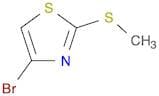
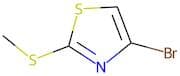
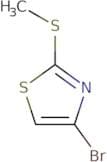
CAS 204513-62-2
:4-Bromo-2-(methylthio)thiazole
Description:
4-Bromo-2-(methylthio)thiazole is an organic compound characterized by its thiazole ring, which is a five-membered heterocyclic structure containing both sulfur and nitrogen atoms. The presence of a bromine atom at the 4-position and a methylthio group at the 2-position contributes to its unique chemical properties. This compound is typically a pale yellow to brown solid and is soluble in organic solvents. It exhibits biological activity, making it of interest in pharmaceutical research, particularly for its potential antimicrobial and antifungal properties. The thiazole moiety is known for its role in various biological systems and can participate in diverse chemical reactions, including nucleophilic substitutions and electrophilic aromatic substitutions. Additionally, the bromine substituent can enhance the compound's reactivity and influence its interaction with biological targets. Safety data should be consulted for handling, as halogenated compounds can pose health risks. Overall, 4-Bromo-2-(methylthio)thiazole is a valuable compound in synthetic organic chemistry and medicinal chemistry research.
Formula:C4H4BrNS2
InChI:InChI=1S/C4H4BrNS2/c1-7-4-6-3(5)2-8-4/h2H,1H3
InChI key:InChIKey=YGCKEBOZMZSIDW-UHFFFAOYSA-N
SMILES:S(C)C1=NC(Br)=CS1
Synonyms:- 4-Bromo-2-(methylthio)thiazole
- 4-Bromo-2-methylsulfanylthiazole
- Thiazole, 4-bromo-2-(methylthio)-
Sort by
Purity (%)
0
100
|
0
|
50
|
90
|
95
|
100
Found 4 products.
Thiazole, 4-bromo-2-(methylthio)-
CAS:Formula:C4H4BrNS2Purity:98%Color and Shape:SolidMolecular weight:210.11534-Bromo-2-(methylthio)-1,3-thiazole
CAS:4-Bromo-2-(methylthio)-1,3-thiazolePurity:≥95%Color and Shape:SolidMolecular weight:210.12g/mol4-Bromo-2-(thiomethyl)thiazole
CAS:4-Bromo-2-(thiomethyl)thiazole is an alkylating agent that has anticancer activity. It can be used to synthesize a variety of analogs, which are functional molecules with similar or improved properties. 4-Bromo-2-(thiomethyl)thiazole is hydrophobic, but has been shown to be reactive in simulations and functionalities such as the enolate form. This molecule predominately forms a ferroptosis, which is a type of cyclopentenone. The cancer cells are stabilized by this molecule's biomolecular interactions.
Formula:C4H4BrNS2Purity:Min. 95%Molecular weight:210.12 g/mol