CymitQuimica logo

CAS 20525-62-6

:

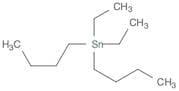
dibutyl(diethyl)stannane

Description:
Dibutyl(diethyl)stannane, with the CAS number 20525-62-6, is an organotin compound characterized by its structure, which includes two butyl groups and two ethyl groups bonded to a tin atom. This compound typically appears as a colorless to pale yellow liquid and is known for its relatively low volatility and high stability under standard conditions. It is primarily used in organic synthesis and as a reagent in various chemical reactions, particularly in the field of organometallic chemistry. Dibutyl(diethyl)stannane exhibits properties typical of organotin compounds, such as potential toxicity and environmental concerns, particularly regarding its bioaccumulation and effects on aquatic life. Safety precautions are essential when handling this substance, as it may pose health risks through inhalation or skin contact. Additionally, it is important to note that organotin compounds are subject to regulatory scrutiny due to their environmental impact, leading to restrictions in certain applications. Overall, dibutyl(diethyl)stannane serves as a valuable tool in synthetic chemistry while necessitating careful handling and consideration of its ecological footprint.
Formula:C12H28Sn
InChI:InChI=1/2C4H9.2C2H5.Sn/c2*1-3-4-2;2*1-2;/h2*1,3-4H2,2H3;2*1H2,2H3;/rC12H28Sn/c1-5-9-11-13(7-3,8-4)12-10-6-2/h5-12H2,1-4H3
SMILES:CCCC[Sn](CC)(CC)CCCC
Synonyms:
  • Dibutyldiethylstannane
  • Stannane, dibutyldiethyl-
  • Dibutyl(diethyl)stannane
Sort by

Purity (%)
0
100
|
0
|
50
|
90
|
95
|
100
Found 4 products.
  • Stannane, dibutyldiethyl-

    CAS:
    Formula:C12H28Sn
    Color and Shape:Liquid
    Molecular weight:291.0517

    Ref: IN-DA0029Z7

    ne
    To inquire
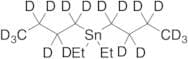
  • Dibutyldiethyltin-d18

    Controlled Product
    CAS:
    <p>Applications Dibutyldiethyltin belongs to a class of organotin compounds that are commonly used as pesticides and fungicides and as plastics additives.<br> Not a dangerous good if item is equal to or less than 1g/ml and there is less than 100g/ml in the package<br>References Krupp, E.M. et al.: Environ. Sci. Technol., 45, 943 (2011);<br></p>
    Formula:C12H10D18Sn
    Color and Shape:Colourless
    Molecular weight:309.17

    Ref: TR-D429457

    5mg
    256.00€
    50mg
    1,690.00€
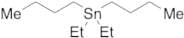
  • Dibutyldiethyltin

    Controlled Product
    CAS:
    <p>Applications Dibutyldiethyltin belongs to a class of organotin compounds that are commonly used as pesticides and fungicides and as plastics additives.<br>References Krupp, E.M. et al.: Environ. Sci. Technol., 45, 943 (2011)<br></p>
    Formula:C12H28Sn
    Color and Shape:Neat
    Molecular weight:291.06

    Ref: TR-D429455

    1g
    2,060.00€
    100mg
    318.00€
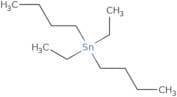
  • Dibutyldiethyltin

    CAS:
    <p>Dibutyldiethyltin is a divalent hydrocarbon that has been used as an agrochemical to control weeds. It is a monomer that can be polymerized to form polydibutyldiethyltin (PDDBT). Dibutyldiethyltin has optical properties, such as a high refractive index and low viscosity, which make it useful for specialty optical applications. The chemical structure of PDDBT consists of a chlorine atom and two fluorine atoms attached to two ethyl groups. PDDBT also contains two methyl groups with ether linkages. This compound is insoluble in water, but soluble in organic solvents and deionized water. Hydrogenation of PDDBT yields a ring-opening product known as dibutyltindiacetate.</p>
    Formula:C12H28Sn
    Purity:Min. 95%
    Molecular weight:291.1 g/mol

    Ref: 3D-VAA52562

    10mg
    To inquire
    25mg
    To inquire
    50mg
    To inquire
    100mg
    To inquire
    250mg
    To inquire