CAS 205444-22-0
:2-chloro-4-iodo-6-(trifluoromethyl)pyridine
Description:
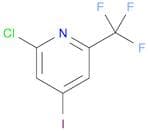
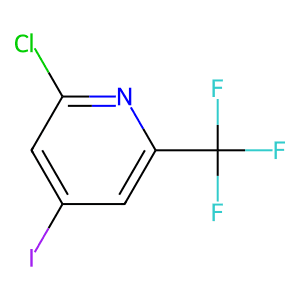
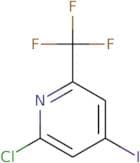
2-Chloro-4-iodo-6-(trifluoromethyl)pyridine is a heterocyclic aromatic compound characterized by its pyridine ring, which is a six-membered ring containing one nitrogen atom. This compound features a chlorine atom at the 2-position, an iodine atom at the 4-position, and a trifluoromethyl group (-CF3) at the 6-position of the pyridine ring. The presence of these substituents significantly influences its chemical properties, including its reactivity and polarity. The trifluoromethyl group is known for imparting strong electron-withdrawing characteristics, which can enhance the compound's electrophilicity. Additionally, the halogen substituents (chlorine and iodine) can participate in various chemical reactions, such as nucleophilic substitutions or coupling reactions. This compound is of interest in medicinal chemistry and materials science due to its potential applications in drug development and as a building block for more complex molecules. Its unique combination of halogen atoms and a trifluoromethyl group makes it a valuable compound for further research and synthesis in various chemical contexts.
Formula:C6H2ClF3IN
InChI:InChI=1/C6H2ClF3IN/c7-5-2-3(11)1-4(12-5)6(8,9)10/h1-2H
SMILES:c1c(cc(Cl)nc1C(F)(F)F)I
Synonyms:- Pyridine, 2-Chloro-4-Iodo-6-(Trifluoromethyl)-
- 2-Chloro-4-iodo-6-(trifluoromethyl)pyridine
Sort by
Purity (%)
0
100
|
0
|
50
|
90
|
95
|
100
Found 4 products.
Pyridine, 2-chloro-4-iodo-6-(trifluoromethyl)-
CAS:Formula:C6H2ClF3INPurity:98%Color and Shape:SolidMolecular weight:307.43952-Chloro-4-iodo-6-(trifluoromethyl)pyridine
CAS:2-Chloro-4-iodo-6-(trifluoromethyl)pyridinePurity:98%Color and Shape:Light Tan SolidMolecular weight:307.44g/mol2-Chloro-4-iodo-6-(trifluoromethyl)pyridine
CAS:Formula:C6H2ClF3INPurity:97%Color and Shape:SolidMolecular weight:307.442-Chloro-4-iodo-6-(trifluoromethyl)pyridine
CAS:2-Chloro-4,6-difluoro-pyridine is an electrophilic compound that can react with nucleophiles to form covalent bonds. This reaction is known as nucleophilic substitution and it can be used in the synthesis of organic compounds. The diisopropylamide of lithium is a popular reagent for this purpose because it is inexpensive, highly reactive, and easily purified by distillation. In particular, 2-chloro-4,6-difluoro-pyridine reacts quantitatively with lithium diisopropylamide to form 4-(2-chloro-4,6-difluoro)pyrimidin-2(1H)-ones in tetrahydrofuran.Formula:C6H2ClF3INPurity:Min. 95%Color and Shape:Solid.Molecular weight:307.44 g/mol